
Preventing Skin Allergy Claims with Your Organic Sanitary Pad Supplier: A Problem-Solution Guide
A skin allergy complaint does not stay with the consumer who experienced it. It travels: from the user to the pharmacy or supermarket counter, from the counter to the brand owner or importer who placed the purchase order, and from the importer back to the supplier who produced the pads. By the time that question reaches the supply chain, the practical issue is no longer comfort. It is evidence — which document describes the fabric that touched the skin, and does that document actually cover the goods that were delivered.
This guide is written for importers, retail chain buyers, pharmacy channel distributors and private-label brand owners sourcing eco friendly organic sanitary pads. It defines the complaint problem first, then sets out a five-layer documentation framework: skin-contact raw material biocompatibility testing, component-level testing of an identified gusset fabric, finished-product skin allergy testing, product performance verification, and market-scope certificates. Skin allergy test report No. 252004820 is used as the working example throughout, because its combination of a named sample identity and a long-dated validity record makes it a practical risk-management asset rather than a marketing document.
Problem Definition: Why a Downstream Skin Allergy Complaint Becomes the Buyer's Problem
The complaint itself is usually short. A consumer reports itching, redness or irritation after using a pad. What follows is a documentation request aimed at the party that put the product on the shelf: the importer, distributor or private-label brand. If that party cannot produce a test document that names the material in question, the claim gets negotiated on commercial terms instead of technical ones.
The gap appears because most buyers qualify a supplier with documents that prove systems and conformity, not skin-contact safety of a named fabric. A CE Declaration of Conformity, an ISO 9001 certificate or a general product test report does not, by itself, answer the question "was this specific skin-contact material tested for sensitization and allergy potential?"
A second, less visible failure mode is specification drift. Between the first order and the fifth, a topsheet supplier changes, an absorbent core is re-sourced, or a period-pants gusset fabric is replaced to reduce cost. The original test document remains in the file, but it no longer describes the delivered product. In a skin allergy enquiry, that mismatch is the weakest point in the buyer's position.
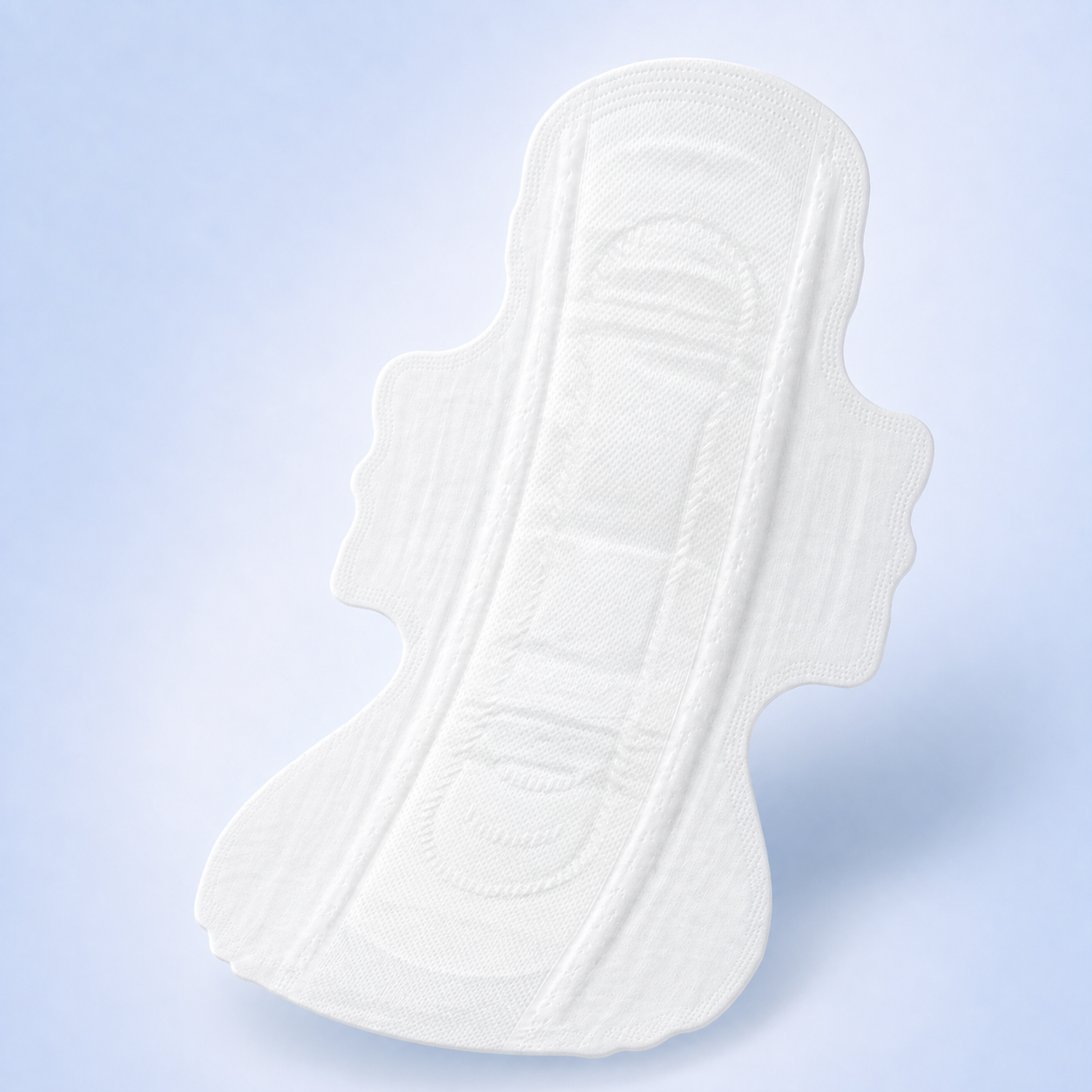
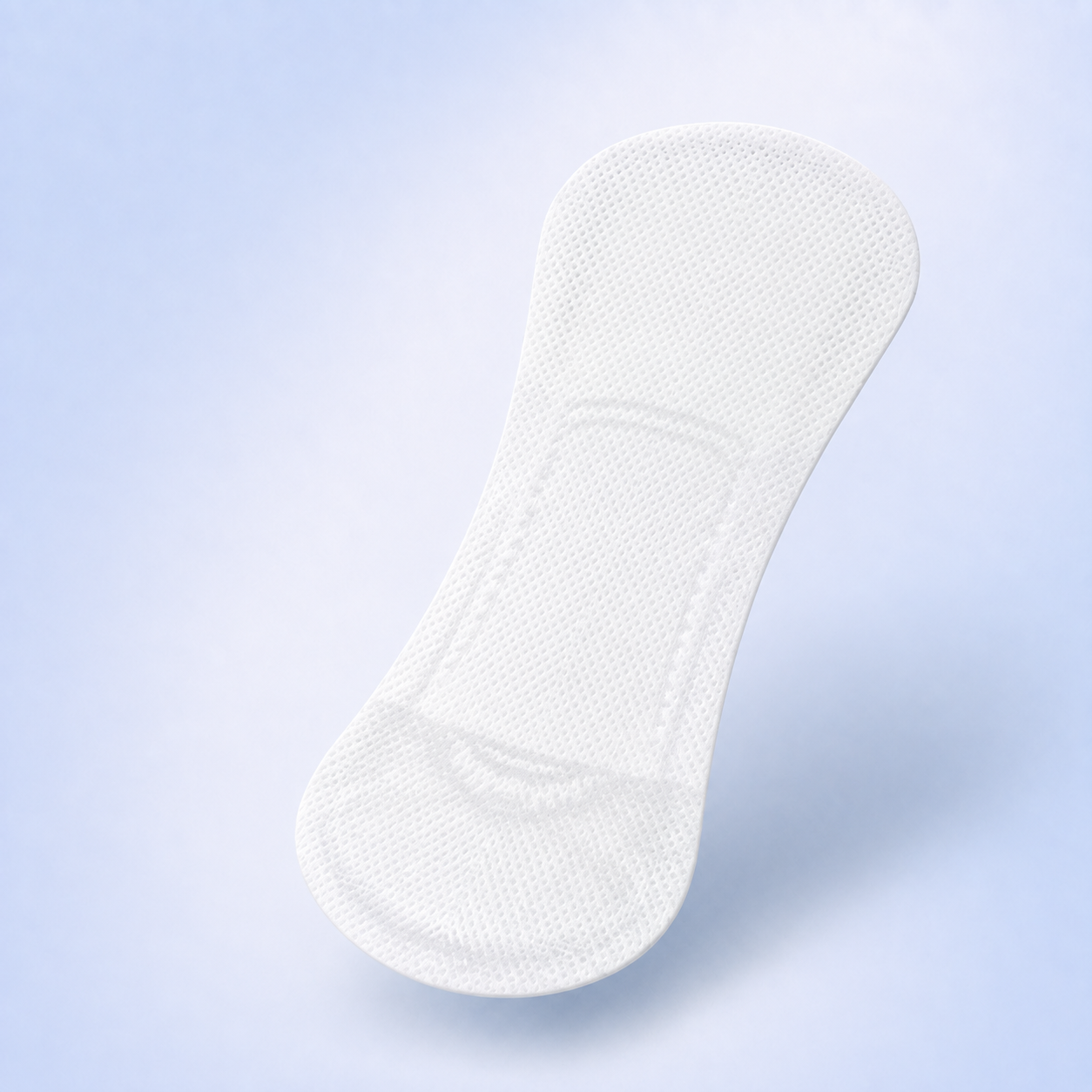
Mapping the skin-contact layers of an organic sanitary pad or panty liner makes the risk concrete:
- Top sheet — 100% organic cotton or bamboo fiber nonwoven, in continuous direct contact.
- Side layer and wings — soft nonwoven fabric, in friction contact during movement.
- Absorbent core — fluff pulp and SAP, normally behind the topsheet but relevant if strike-through occurs.
- Back sheet — breathable PE film or a biodegradable film option.
- Adhesive and release paper — contact with the garment and, indirectly, the skin.
- Gusset fabric — in disposable period pants and menstrual pants, the layer with the longest continuous contact time.
Industry Background: Why Skin-Safety Documentation Is Now a Purchasing Criterion
The commercial context explains the pressure. Market research published by TechSci Research projects the global organic sanitary napkins market reaching USD 3.02 billion in 2025 and growing to USD 4.51 billion by 2031, while Mark & Spark Solutions reports a 20.1% compound annual growth rate for the biodegradable sanitary napkins segment between 2024 and 2030. Dataintelo places Asia Pacific at a 38.6% revenue share of the biodegradable sanitary napkins market in 2025. Fast growth in eco-positioned period care means more suppliers, more private-label launches and more products sitting on pharmacy shelves under a claim-heavy label.
Regulation is moving in the same direction. Industry commentary on the United States market notes that the FDA Quality Management System Regulation (QMSR), which incorporates ISO 13485:2016 into 21 CFR Part 820, takes effect on February 2, 2026 for menstrual products — a point buyers should confirm with their own regulatory advisor for their product category and channel. On the trade side, sanitary towels, pads and tampons are classified under Harmonized System code 9619.00, which is relevant when customs or market surveillance requests product documentation.
For procurement teams, the practical conclusion is straightforward: skin-safety documentation has moved from a "nice to have" attachment to a qualification input. Buyers comparing organic sanitary pads manufacturers increasingly ask for report numbers before they ask for price, because a report number is the only element of a supplier claim that a third party can verify independently.
Detailed Solution: A Five-Layer Skin-Safety Documentation Framework
The framework below is designed to be requested at supplier qualification stage, not after a complaint. Each layer answers a different question, and each layer carries an identifier that can be written into a purchase specification.
Layer 1 — Skin-Contact Raw Material Biocompatibility
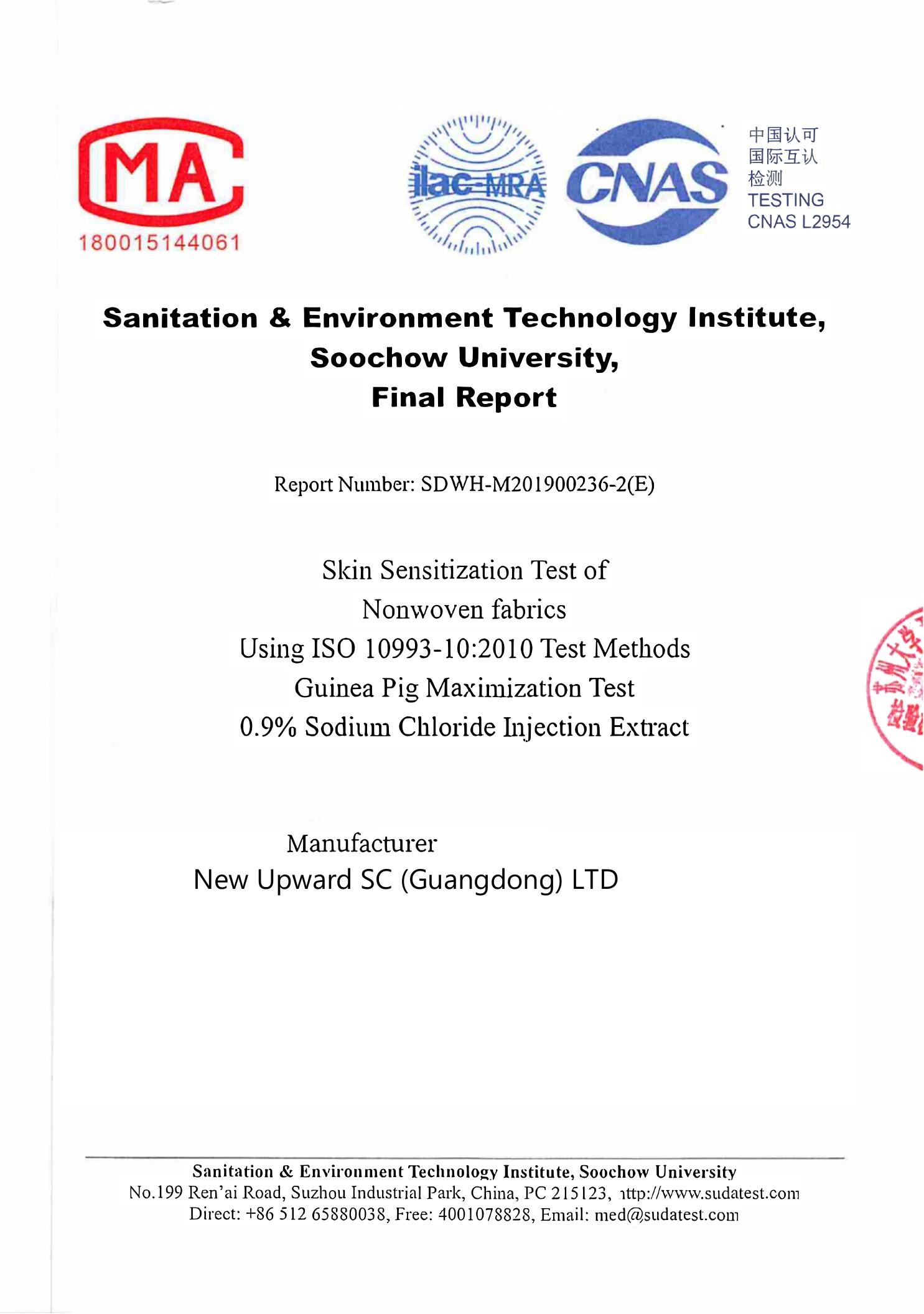
Non-woven fabrics are the skin-contact raw material of feminine hygiene products, and they are tested as materials rather than as finished products. New Upward's documentation set includes three reports on non-woven fabrics issued by the Sanitation & Environment Technology Institute, Soochow University:
- In Vitro Cytotoxicity Test Report No. SDWH-M201900236-1 (E), applying the ISO 10993-5:2009 test method.
- Skin Sensitization Test Report No. SDWH-M201900236-2 (E), applying the ISO 10993-10:2010 test method.
- Skin Irritation Test Report No. SDWH-M201900236-3 (E), applying the ISO 10993-10:2010 test method.
The scope statement on these reports is "non-woven fabrics, skin-contact raw material for feminine hygiene products". That wording matters: it tells a buyer that the tested object is the fabric class used in the topsheet and side layers, so a material substitution is a trigger to re-check the documentation rather than an internal cost decision.
Layer 2 — Component-Level Testing of the Identified Gusset Fabric
This is the layer most buyers miss, and it is exactly where downstream complaints concentrate. In disposable period pants and menstrual pants, the gusset fabric is the component with the longest continuous skin contact, and it can be sourced independently from the pad materials.
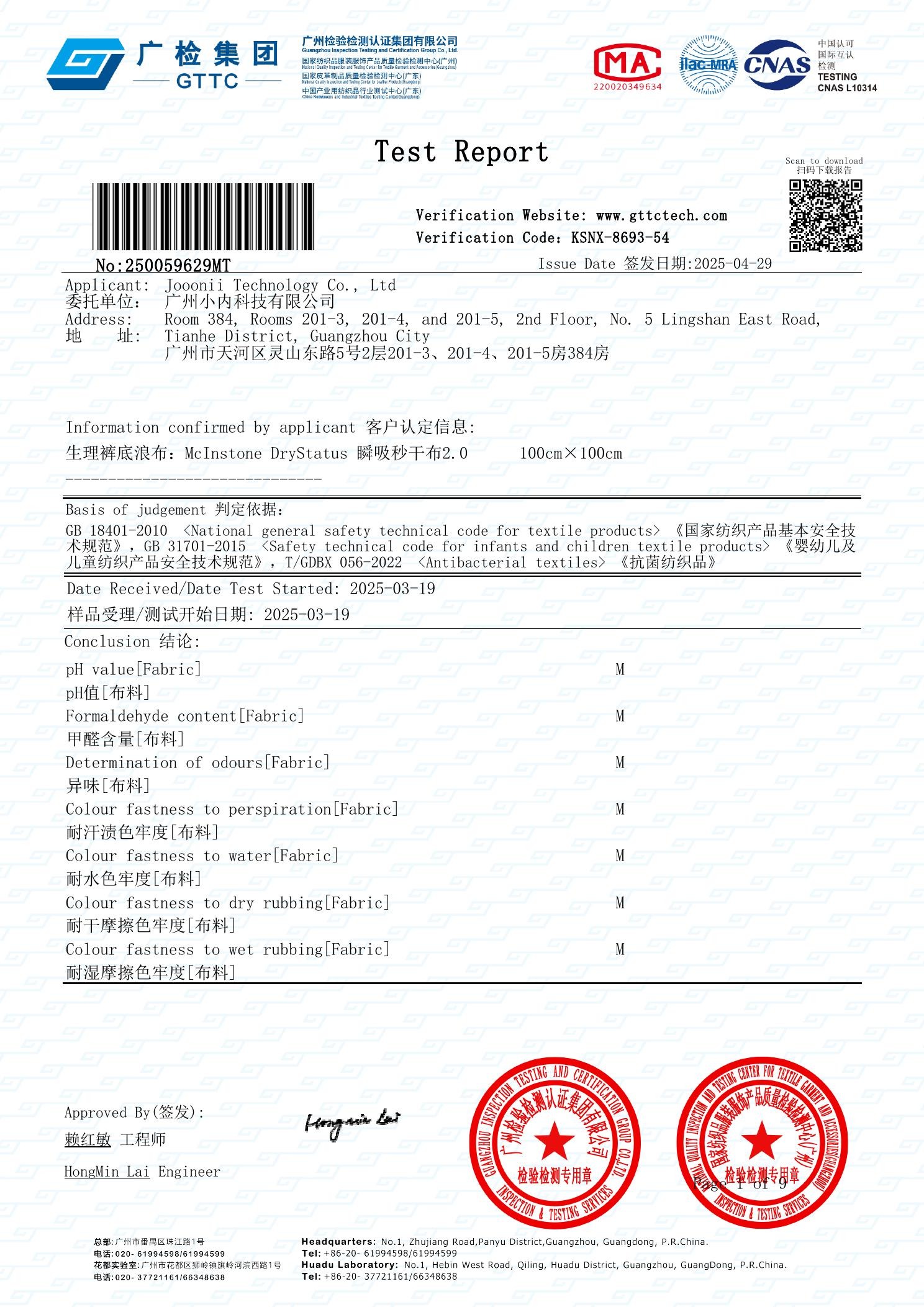
The documentation record for this layer is the Antibacterial Menstrual Pants Test Report No. 250059629MT, issued by Guangzhou Testing and Certification Group Co., Ltd. The recorded sample is the menstrual pant gusset fabric McInstone DryStatus 2.0, 100 cm × 100 cm, tested against GB 18401-2010, GB 31701-2015 and T/GDBX 056-2022, with an issue date of 2025-04-29.
The actionable rule that follows is simple: if a project uses a gusset fabric, the specification file should name that fabric and its report number. A finished-pad report does not cover a gusset fabric, and a gusset fabric report does not cover a topsheet. Component-level documentation closes that gap before an enquiry opens it.
Layer 3 — Finished-Product Skin Allergy Testing: Report No. 252004820
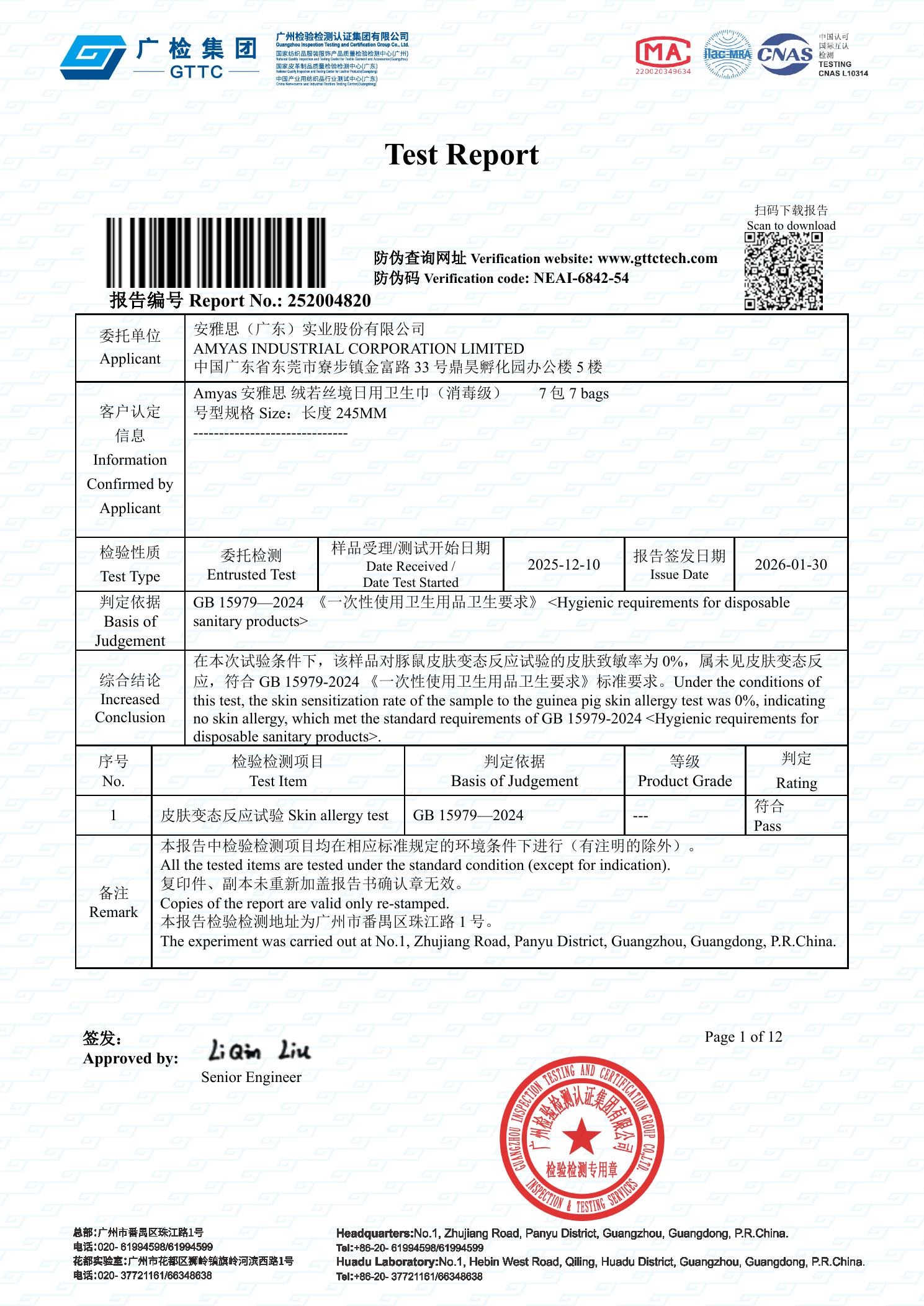
The third layer applies the material evidence to a finished product. The reference document here is the Skin Allergy Test Report No. 252004820, issued by Guangzhou Inspection Testing and Certification Group Co., Ltd. (GTTC). The recorded scope is Amyas disposable sanitary pads (sterilized grade), size 245 mm, tested against GB 15979-2024, the hygienic requirements standard for disposable sanitary products, with an issue date of 2026-01-30.
The commercial value of this document comes from two details. First, it names a product identity and a size, so a buyer can compare it against the actual SKU being purchased instead of accepting a generic skin-safety statement. Second, the record shows an expiry date of 2099-01-01, which means the document carries no short renewal cycle of its own. For a retailer or pharmacy buyer building a supplier file, that removes an annual documentation chase from the onboarding process.
Used this way, report No. 252004820 is not a sales attachment. It is the anchor of a proactive answer to the question every importer will eventually face: what evidence existed before the complaint, not after it.
Layer 4 — Product Performance, Hygiene and Material-Function Testing
Skin safety sits alongside performance and hygiene evidence, and the same specification file should carry both. For the Lilimolone Ultra-Thin Bamboo Sanitary Pads, 245 mm, the product test report is Report No. 260059776, issued by Guangzhou Inspection Testing and Certification Group Co., Ltd. (GTTC), covering physical-chemical and hygiene safety testing in accordance with GB/T 8939-2018 for sanitary absorbent pads and panty liners and GB 15979-2024, with an issue date of 2026-04-01.
For bamboo fiber material function, the documentation set includes Report No. 210285558, an antimicrobial activity test on 100% bamboo fiber spunlace non-woven fabric under GB/T 20944.3-2008, issued 2021-09-23, and Report No. 2025FM19954R01E with verification code LU9T6NKP, an antimicrobial activity test on the Lilimolone bamboo fiber sanitary pad surface layer issued by the Guangdong Detection Center of Microbiology (Gmicro Testing) on 2025-11-19.
These reports support material-function statements, not medical claims. Antimicrobial material testing does not automatically support a disease-prevention or treatment claim, and packaging wording should be reviewed against target-market labeling rules before printing.
Layer 5 — Material Scope, System and Market-Access Documents
The final layer connects product evidence to the market the goods are sold into. In the New Upward documentation set, this includes certified organic cotton material scope certificates from ECOCERT Greenlife S.A.S. — GOTS Organic Textile Standard Version 7.0 under Scope Certificate No. EGL/236426/GOTS/236426260101190405, and OCS Organic Content Standard Version 3.0 under Scope Certificate No. EGL/236426/OCS/236426260101190029, both covering the period 2026-01-01 to 2026-12-31. FSC Chain of Custody coverage is recorded under certificate number RINA-COC-001701 / DCI-COC-000148 for FSC Mix pulp supply.
System and market documents complete the picture: ISO 9001:2015 Quality Management System Certificate No. CN21/31472 issued by SGS United Kingdom Ltd.; ISO 14001:2015 Environmental Management System Certificate No. 51823E08205R0; Halal Certificate No. 44521209189851 for Middle East, Southeast Asia and Muslim consumer markets; CE Declaration of Conformity for Feminine Hygiene Pads, document No. H-YG-MD-240414161/01, referencing Medical Device Regulation (EU) 2017/745 and the ISO 10993 series; an EU Authorized Representative Agreement with WeTapeV Euro s.r.o. valid from 2026-04-16 to 2027-04-16; EAC State Registration for the EAEU market; U.S. FDA establishment registration recorded under numbers 10088919 and 3010200123; and the Sanitary Products Production and Sales Enterprise Service Level Qualification Certificate (Level 1), certificate No. SSDY20260609102, issued 2026-06-09 and valid to 2029-06-08.
One accuracy note belongs in every buyer checklist: for U.S. FDA establishment registration, the certificate itself states that the FDA does not issue or recognize certificates of registration. The registration record is the evidence; it should not be presented as an approval.
Step-by-Step Breakdown: Qualifying a Supplier for Skin-Safety Documentation in Seven Steps
- Map the skin-contact layers of your SKU. List the topsheet, side layer and wings, core, back sheet, adhesive and — where relevant — the gusset fabric. Documentation requests should follow this list, not a generic certificate checklist.
- Define the claim risk per market and channel. Pharmacy and premium retail channels carry more documentation scrutiny than discount channels; EU, EAEU, U.S., Middle East and Southeast Asian markets each have different document expectations.
- Request documents by identifier. Ask for report name, report number, issuing laboratory, tested sample identity, standard applied, issue date and validity record. A report number is verifiable; a screenshot is not.
- Match the tested sample to your specification. Compare product type, grade, size and material against your SKU. Report No. 252004820, for example, records a 245 mm sterilized-grade product — check that this matches the item you are buying.
- Cross-check material certificates against the actual bill of materials. GOTS and OCS scope certificates support organic cotton material claims; FSC Chain of Custody supports FSC Mix pulp supply. Neither substitutes for skin-contact testing.
- Confirm change control and batch traceability. Ask how the supplier handles a material substitution, and whether incoming material inspection, in-process inspection, finished-goods sampling, retained samples and batch traceability are in place. New Upward's documented quality-control sequence covers these steps.
- Freeze the documentation before packaging artwork is printed. Certificate marks and claims should only appear on the pack where certificate scope and brand authorization allow it.

Use Cases: How the Framework Works in Real Sourcing Projects
Pharmacy and Retail Chain Onboarding
In one documented retail project, a buyer with more than 200 retail stores in the United States and 58 pharmacy stores in Saudi Arabia launched organic cotton biodegradable sanitary pads for daily feminine hygiene care. The project completed product launch and validation in roughly two to three months, with the recorded outcome of a successful retail shelf rollout, more than 30% reported category sales share in selected stores, about 15% higher margin than regular sanitary pads, and a zero return record during the launch period. The relevant point for this guide is the structure behind that result: organic cotton topsheet, biodegradable material option, clear eco-positioning, stable leakage protection and private-label packaging support — all supported by documentation that a pharmacy buyer could review before shelf placement.
EU Private-Label Launch
An EU-bound project needs the market-access layer to be complete before shipping. The CE Declaration of Conformity for Feminine Hygiene Pads (document No. H-YG-MD-240414161/01) and the EU Authorized Representative Agreement with WeTapeV Euro s.r.o., valid from 2026-04-16 to 2027-04-16, are the documents that connect the product file to EU obligations. Buyers should confirm current applicability with their own compliance advisor for the specific SKU and channel.
Period Pants and Menstrual Pants Projects
Where the project includes disposable period pants, the gusset fabric becomes a required documentation line of its own. Report No. 250059629MT records the McInstone DryStatus 2.0 gusset fabric as the tested sample, which gives the buyer a component-level reference to place beside the pad-level report instead of relying on one document to describe two different products.
Long-Run Private-Label Development
For an emerging feminine care brand in Taiwan, China, development covered four rounds of customized sampling and refinement before the initial order, then expanded from a single size to daytime, overnight and extra-long overnight sanitary pads plus disposable period pants in multiple sizes, supplied in 40HQ containers across more than three years of repeat orders. Sample validation at that level is the operational discipline that keeps documentation accurate: the approved sample, the specification and the report should describe the same product.
Comparison Table: Which Document Answers Which Question
The table below maps the documentation layers described above to the buyer question each one answers. All identifiers are taken from the supplier's documentation set.
| Buyer question | Document type | Document identifier | Scope / standard |
|---|---|---|---|
| Is the skin-contact non-woven biocompatible? | In vitro cytotoxicity test | Report No. SDWH-M201900236-1 (E) | ISO 10993-5:2009; non-woven fabrics, skin-contact raw material |
| Could the fabric sensitize skin? | Skin sensitization test | Report No. SDWH-M201900236-2 (E) | ISO 10993-10:2010; non-woven fabrics |
| Could the fabric irritate skin? | Skin irritation test | Report No. SDWH-M201900236-3 (E) | ISO 10993-10:2010; non-woven fabrics |
| Has a finished pad passed a skin allergy test? | Skin allergy test report | Report No. 252004820 (GTTC) | GB 15979-2024; Amyas disposable sanitary pads (sterilized grade), 245 mm |
| Is the gusset fabric of menstrual pants tested? | Component test report | Report No. 250059629MT | GB 18401-2010, GB 31701-2015, T/GDBX 056-2022; McInstone DryStatus 2.0 gusset fabric |
| Does the named pad meet product standards? | Product test report | Report No. 260059776 (GTTC) | GB/T 8939-2018; GB 15979-2024; Lilimolone Ultra-Thin Bamboo Sanitary Pads 245 mm |
| Is bamboo fiber material function tested? | Antimicrobial activity test | Report No. 210285558; Report No. 2025FM19954R01E (code LU9T6NKP) | GB/T 20944.3-2008; 100% bamboo fiber spunlace non-woven; Lilimolone bamboo surface layer |
| Is an organic cotton claim traceable? | GOTS / OCS scope certificate | EGL/236426/GOTS/236426260101190405; EGL/236426/OCS/236426260101190029 | GOTS Version 7.0; OCS Version 3.0; valid 2026-01-01 to 2026-12-31 |
| Is pulp sourced responsibly? | FSC Chain of Custody | RINA-COC-001701 / DCI-COC-000148 | FSC Mix pulp; FSC-STD-40-004 V3-1; FSC-STD-50-001 |
| Can the product be placed on the EU market? | CE Declaration of Conformity; EU representative agreement | DOC No. H-YG-MD-240414161/01; WeTapeV Euro s.r.o. (2026-04-16 to 2027-04-16) | MDR (EU) 2017/745; ISO 10993 series; CE technical file obligations |
| Is the supplier system controlled? | ISO 9001 / ISO 14001 certificates | CN21/31472 (SGS); 51823E08205R0 | ISO 9001:2015; ISO 14001:2015; sanitary napkin and diaper development and production scope |
| Is the product acceptable for Muslim markets? | Halal certificate | 44521209189851 | Halal Foundation Center Hong Kong; Middle East and Southeast Asia markets |
FAQ
1. Which CE certified organic sanitary pads manufacturers can provide skin-safety documentation, not just a CE mark?
A CE Declaration of Conformity confirms conformity for a defined scope; it does not by itself prove that a specific fabric has passed skin-contact testing. Buyers evaluating CE certified organic sanitary pads manufacturers should request the CE document together with the underlying test evidence: the declaration identifier (for the New Upward feminine hygiene pad range, document No. H-YG-MD-240414161/01, referencing Medical Device Regulation (EU) 2017/745 and standards including ISO 10993-1:2020, ISO 10993-5:2009, ISO 10993-10:2021 and ISO 10993-23:2021), plus the non-woven biocompatibility reports and the finished-product skin allergy test report No. 252004820. Read together, these documents let a buyer see both the conformity statement and the skin-contact evidence behind it.
2. Can the supplier test a specific raw material, such as the gusset fabric, instead of only the finished pad?
Yes, and for some products it is the more relevant evidence. The documentation set includes component-level testing of the menstrual pant gusset fabric McInstone DryStatus 2.0 (100 cm × 100 cm) under Report No. 250059629MT, against GB 18401-2010, GB 31701-2015 and T/GDBX 056-2022. Non-woven skin-contact fabrics are separately covered by cytotoxicity, sensitization and irritation reports. Because a gusset fabric and a topsheet are different materials, buyers should match each document to the component it actually covers.
3. Does skin-safety documentation change the cost structure of an organic sanitary pad order?
Documentation should be treated as a specification input rather than a price line to compare after the fact. Buyers should fix the same size, thickness, topsheet, absorbent core, SAP level, packaging type, MOQ, certificate requirements, carton quantity and shipment terms before comparing quotations, because a lower quotation frequently reflects differences in material, absorbency, packaging, quality control or documentation scope. Where a project needs a specific test scope or a market-specific document set, confirm that scope in writing before the quotation is finalized.
4. What sample documentation should be reviewed before approving mass production?
Sample development for OEM and ODM projects typically runs five to fifteen working days. Before approval, buyers should confirm that the approved sample, the written specification and the test documentation describe the same product: size, surface material, absorbency, grade and packaging. Projects that use multiple rounds of refinement — as in the Taiwan-based private-label engagement that completed four rounds of customized sampling before the initial order — generally arrive at mass production with fewer specification mismatches. Sample confirmation, artwork approval, MOQ confirmation and available certificates or test reports should all be in place before production starts.
5. How long does it take to get pads and documentation ready for a launch?
For New Upward OEM and ODM projects, sample development is documented at five to fifteen working days, a new order at about 25 to 30 days after specification and artwork confirmation, and a repeat order at about 15 to 20 days. Where a report such as skin allergy test report No. 252004820 already exists in the file with a long-dated validity record, the documentation does not need to be created again for the same tested scope — the buyer's task becomes confirming that the scope matches the SKU. To start a documentation review, request the sample pack and the certificate and test-report list together: email info@newupward.com, message the team on WhatsApp at +86 157-9847-3913, or download the sanitary pad catalogue at E-catalog of sanitary pads – New Upward.
Conclusion: Move the Evidence Before the Claim
Skin allergy complaints are handled commercially when the buyer has no technical evidence and technically when the buyer does. The difference is not the size of the supplier — it is whether the skin-contact layers of the product were documented before the order, and whether those documents still describe the goods being delivered.
The five-layer framework gives importers, distributors and private-label brands a repeatable qualification routine: raw material biocompatibility for non-woven fabrics under ISO 10993-5 and ISO 10993-10; component-level testing of identified fabrics such as the menstrual pant gusset fabric under Report No. 250059629MT; finished-product skin allergy testing under Report No. 252004820, whose record shows both a defined 245 mm sterilized-grade sample and a validity date of 2099-01-01; product performance evidence under Report No. 260059776; and market-scope documents including GOTS, OCS, FSC, ISO 9001, ISO 14001, Halal, CE and EU representative coverage.
Lilimolone is the feminine care product line supplied through New Upward Supply Chain (Guangdong) Co., Ltd., a Shenzhen-based disposable hygiene manufacturing and supply-chain partner founded in 2017, operating a 200,000 m² facility with more than 10 engineers and an export share of about 80% across Europe, North America, the Middle East, Africa, Southeast Asia, Central Asia and South America. The company supports OEM, ODM and private-label programs covering pad length, shape, thickness, absorbency, wings, organic cotton or bamboo fiber topsheet, pulp and SAP core structure, plant-based backsheet options, wrapper, pack count and packaging artwork, with monthly capacity of approximately 450 million sanitary pads under full-line operation.
Build the documentation layer before the first purchase order
Request organic sanitary pad samples together with the certificate and test-report list, and confirm which documents apply to your target market and SKU. Contact: Laura — info@newupward.com / WhatsApp +86 157-9847-3913. Official site: www.newupward.com. Address: A4-02, Building A, No.108, Lijia Road, Henggang Street, Longgang District, Shenzhen City, China 518115.
Verification note: test reports and certificates apply to the sample scope stated on each document. Buyers should confirm applicability to their own SKU, market and channel with their compliance advisor before making claims on packaging or in marketing material.
Have Questions or Need More Details?
Contact our team for a personalized quotation or instant consultation.
Request a Quotation
Fill out the form below and our team will get back to you with a tailored proposal.
WhatsApp Direct Chat
Prefer to chat in real-time? Message us on WhatsApp for instant assistance & quick answers.
- Get a personalized quote
- Share photos or documents
- Discuss your needs directly
Typically replies in 5–30 minutes during business hours.