
Supplier Evaluation for Eco Friendly Organic Sanitary Pads: Can One Vendor Cover Docs and Delivery?
Most private-label and retail buyers start this decision from the same place: keep product selection, custom packaging, documentation and logistics with one China supplier, or spread the project across a pad factory, a packaging printer, a compliance agent and a freight forwarder. For eco friendly organic sanitary pads, a single qualified supplier can cover all four layers — but “one-stop service” is a service claim, not a certificate. It has to be verified layer by layer, with document numbers, lead-time commitments and batch-level controls.
New Upward SC (Guangdong) Co., Ltd. (Newupward) is a China-based feminine care and disposable hygiene manufacturing and supply-chain partner serving importers, regional agents, distributors, retail chains, e-commerce brands and private-label owners. Its feminine care range includes Organic Cotton Biodegradable Sanitary Pads (model NU07) and the Lilimolone Ultra-Thin Bamboo Sanitary Pads series, supplied through OEM, ODM and private-label programmes.
This guide converts a Research-stage question into an Evaluation-stage decision: a four-gate supplier evaluation framework, a nine-step verification workflow, a document checklist, and a supplier-model comparison that shows where single-vendor sourcing is safe and where it is not.
Quick answer. Yes — one supplier can cover product selection, custom packaging, export documents and delivery assurance, but only when four things are documented: service-level qualification, product and material evidence, batch-level quality control, and written lead-time commitments. A supplier that cannot produce document numbers, scopes and validity dates should stay in the “coordinated” column, not the “approved” column.
Problem Definition: Where “One Vendor Does Everything” Actually Breaks
Single-vendor sourcing for organic sanitary pads fails in three specific places, and each one has a different failure signature.
- The product layer. Topsheet material (organic cotton versus bamboo fiber nonwoven), absorbent core (fluff pulp and SAP), backsheet (breathable PE film or a biodegradable film option) and individual wrapper must stay identical between the approved sample and mass production. If the supplier coordinates production rather than controlling the specification, absorption, rewet and leakage performance can drift between batches.
- The packaging layer. Individual wrapper, retail pouch, display box, master carton, pack count, artwork, logo, language version and barcode sit with a different team than the pad itself. Packaging MOQ is usually different from product MOQ, so an approved pad specification can still stall at the printing stage.
- The document layer. Material certificates, product test reports, market-entry documents, labeling text and export paperwork. When the factory, the printer and the compliance agent are three separate companies, nobody owns the final document set, and the gap usually surfaces during retail onboarding or at customs.
The opposite failure is just as common: approving a “full-service” supplier on catalogue language and price alone. Two questions separate real capability from a sales claim. First, which layers does the supplier control directly, and which does it coordinate? Second, what document or process proves each layer? A supplier that answers both with names, numbers and process steps can be evaluated. A supplier that answers with adjectives cannot.
Decision rule for buyers: single-vendor sourcing is the lower-risk structure for organic and eco-positioned lines, because the material claim, the packaging claim and the export document set must remain consistent with each other. Multi-vendor sourcing is defensible only when every vendor's layer is separately documented, sampled and tested.
Industry Background: Why Supplier Evaluation Tightened in 2026
Demand for organic and biodegradable period care has moved from niche positioning to standard retail shelf planning. TechSci Research estimated the global organic sanitary pads market at USD 3.02 billion in 2025 and projects growth to USD 4.51 billion by 2031. Within that market, Mark & Spark Solutions projects a 20.1% compound annual growth rate for the biodegradable sanitary napkin segment between 2024 and 2030. Dataintelo reports that Asia Pacific held a 38.6% revenue share of the biodegradable sanitary napkins market in 2025, which is one reason China-based supply-chain evaluation remains central to most sourcing plans.
Trade and regulatory conditions add a second layer. Sanitary towels (pads) and tampons are classified under HS code 9619.00, so importers can compare duty and documentation treatment across markets using the same classification reference. On the compliance side, the FDA's Quality Management System Regulation (QMSR), which incorporates ISO 13485:2016 into 21 CFR Part 820, took effect on 2 February 2026 for menstrual products, raising the practical value of quality-system documentation, batch records and traceability inside supplier evaluation.
The combined effect is straightforward: a supplier that can only send a product photograph and a price is a weak candidate for premium retail, pharmacy or eco-positioned channels. Evaluation weight shifts to document control, lead-time commitment, batch traceability and contingency planning for repeat orders.
Detailed Solution: The Four-Gate Supplier Evaluation Framework
Work through the gates in order. A supplier should not advance to the next gate until the previous one is documented in writing.
Gate 1 — Service-Level and Qualification Documents
The first gate is the least understood and the most useful. Beyond a business licence and factory audit report, buyers can request the supplier's service-level qualification and the product standard it manufactures and sells against.
Newupward holds the Level 1 Sanitary Products Production and Sales Enterprise Service Level Qualification Certificate, No. SSDY20260609102, and manufactures and sells against its enterprise standard Q/SSDY 001-2023. For a buyer these two references do specific work: the certificate number identifies the qualified service scope, and the standard number identifies the specification baseline used for production and inspection.
- Match the certificate number, service scope, issuing body and validity period. Do not accept a cropped image that omits scope.
- Confirm the enterprise standard number appears consistently in the product specification file and, where relevant, in labeling or packaging references.
- Request ISO 9001 and ISO 14001 management certificates to confirm system-level control — but treat them as management evidence, not as product safety evidence.
- Identify which legal entity signs the contract, issues the invoice and appears on export documents. A mismatch here creates customs and warranty problems later.

Gate 2 — Material, Safety and Market Claims
Eco friendly organic sanitary pads carry claims that must trace back to specific evidence. Organize requests into three families and keep them separate, because they are frequently mixed together in supplier presentations.
Family 1 — material origin. GOTS or OCS material scope certificates support organic cotton supply chains, and FSC Chain of Custody documents support FSC mix pulp supply. Organic cotton relates to material origin and certification scope; biodegradable relates to material breakdown. They are separate claims and should be supported separately, not by a single certificate.
Family 2 — skin-contact safety. Request product-level test reports, for example Lilimolone sanitary pads Test Report No. 260059776 for the Lilimolone Ultra-Thin Bamboo Sanitary Pads, together with ISO 10993-5 cytotoxicity, skin sensitization and skin allergy reports for skin-contact safety assessment. Where antimicrobial positioning is used, material-level test evidence should be named: Report No. 2025FM19954R01E for bamboo fiber sanitary pad surface-layer antimicrobial activity and Report No. 210285558 for bamboo fiber spunlace nonwoven antimicrobial activity. One boundary matters here: antimicrobial material testing does not support medical or disease-prevention claims, and local labeling rules should be checked before any such wording is printed.
Family 3 — market-entry documents. CE Declaration of Conformity and EU Representative Agreement support EU market entry; a Halal Certificate addresses Muslim markets; EAC conformity documents support EAEU market access. For all three families the rule is identical: certificate name, type, official number, issuing body, issue and expiry dates, covered product and applicable market must appear in writing.
Buyer note. Ask for the report number, not a photograph of a document folder. A supplier that can list numbers is easier to verify now and easier to audit a year later when the first repeat order is placed.
Gate 3 — Production, Packaging and Batch Control
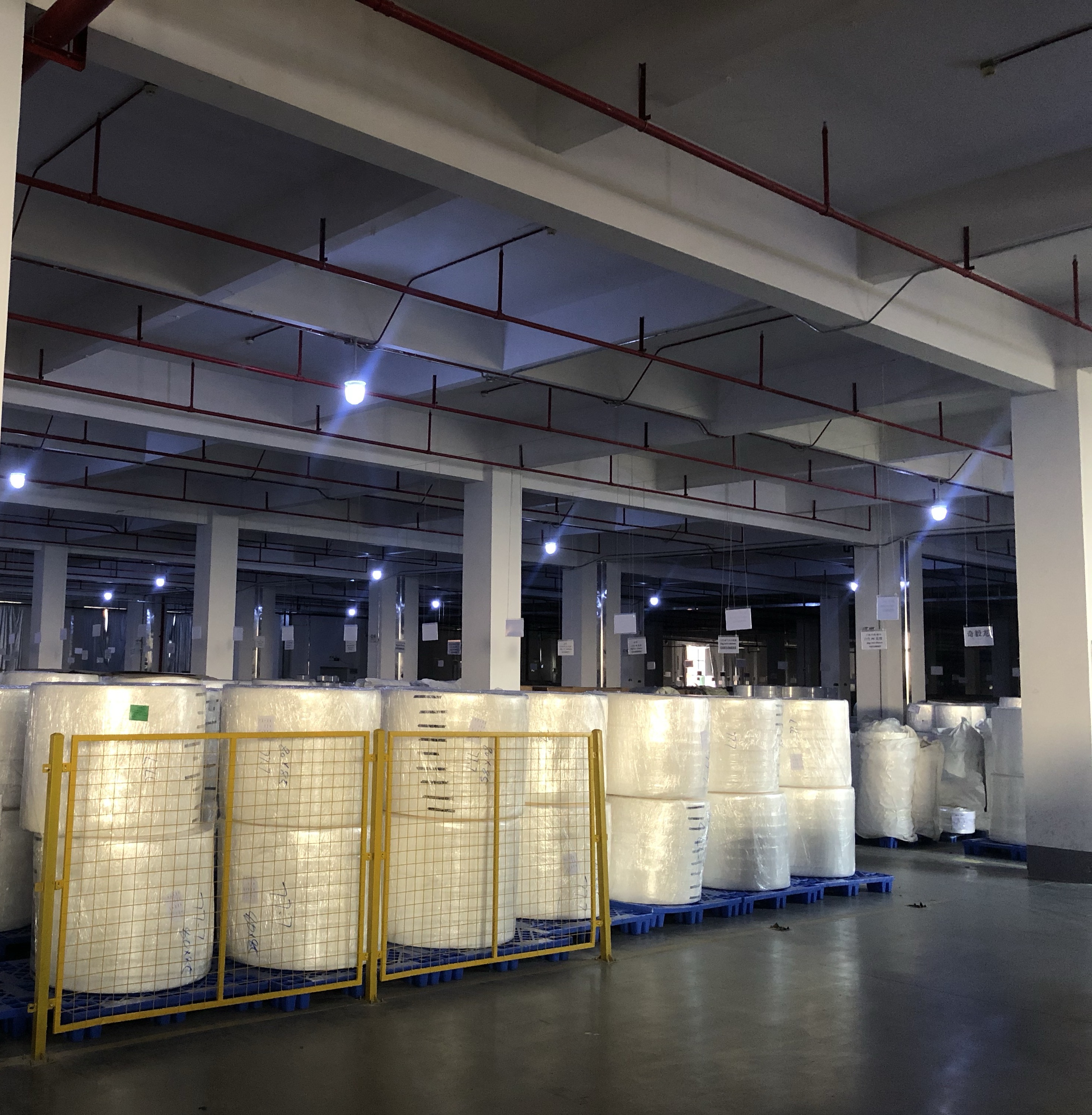
The third gate answers one question: can the specification that was approved survive industrial-scale production? Newupward operates from a 200,000 m² facility with an R&D team of more than 10 engineers, and reports annual output of 5,000,000,000 pads, with approximately 450 million sanitary pads per month under full-line operation. Available capacity depends on product specification, material readiness and production schedule — a figure that should be confirmed in writing for the buyer's shipment window rather than assumed.
Customization scope should be listed line by line, because each item changes tooling, material or artwork: pad length, shape, thickness, absorbency, wings, organic cotton topsheet, fluff-pulp absorbent core, SAP dosage, plant-based backsheet, individual wrapper, pack count, packaging artwork, logo, language version and master carton.
Quality control follows a fixed sequence: incoming material inspection, approved sample control, in-process inspection, absorption, rewet and leakage testing, finished-goods sampling, packaging check, retain samples and batch traceability. Production hygiene supports the same claim set — the workshop includes air shower rooms at the entry sequence to the production area.
- Compare the approved sample against mass production using a documented retain-sample process at both ends.
- Ask for the batch traceability structure: batch number, production date, material lot and packaging lot.
- Confirm absorption, rewet and leakage testing is performed on finished goods, not only during development.
- Confirm who owns the final artwork file and who signs the print proof.

Gate 4 — Delivery Assurance, Lead Time and Repeat-Order Continuity
The fourth gate is where single-vendor decisions are usually won or lost. Documented lead times for Newupward are: sample development 5–15 working days; a new OEM/ODM order about 25–30 days after specification and artwork confirmation; a repeat order about 15–20 days.
Two conditions matter as much as the numbers. First, the production clock for a new order starts after specification and artwork confirmation, which puts packaging approval on the critical path. Second, capacity is not unlimited, so peak-season demand should be reserved in writing rather than assumed.
Export and delivery support covers the United States, Europe, the Middle East, Southeast Asia, Africa, Central Asia and South America, with an 80% export ratio. After-sales scope includes sample and specification confirmation, packaging and compliance document support, order-status follow-up, export documentation, logistics coordination, quality-issue investigation and long-term repeat-order support.
- Keep approved samples and retain samples at both parties so a repeat order can be compared against a reference batch.
- Agree a written escalation path for quality issues: who investigates, expected response time, and how replacement or rework is decided.
- Confirm MOQ in writing. MOQ is project-specific and depends on pad size, materials, packaging printing, pack count and testing requirements; small trial orders can be evaluated based on available materials and mature specifications.
- Reserve capacity for repeat orders instead of re-quoting every cycle.
- Maintain one document folder per SKU: specification, artwork, test reports, certificate references and carton details.

Step-by-Step Breakdown: Running the Evaluation in Nine Steps
- Define the market and product brief. Fix the market (EU, US, Middle East), the channel (pharmacy, retail chain, e-commerce) and the product set: panty liner, day use, night use and extra-long night. Decide the topsheet direction (organic cotton or bamboo fiber nonwoven), absorbency level and packaging language. Checkpoint: one written brief that every supplier answers against.
- Ask each supplier to map its service layers. For product selection, packaging, documentation, QC and export, require the answer “direct control”, “coordinated” or “not offered”. Checkpoint: a written layer map; a supplier that claims everything without naming partners is a downgrade.
- Verify the qualification gate. Confirm Certificate No. SSDY20260609102, enterprise standard Q/SSDY 001-2023, ISO 9001 and ISO 14001 status, and the contracting entity. Checkpoint: number, scope, issuer and validity confirmed.
- Verify the claim gate per SKU. Collect GOTS or OCS material scope certificates, FSC Chain of Custody where FSC mix pulp is used, ISO 10993-5 cytotoxicity, skin sensitization and skin allergy reports, product test reports with numbers (for example No. 260059776), and the relevant market documents: CE Declaration of Conformity and EU Representative Agreement, Halal Certificate or EAC documents. Checkpoint: every packaging claim maps to exactly one document.
- Match customization to the retail plan. Confirm length, thickness, absorbency, wings, topsheet, SAP dosage, backsheet, wrapper, pack count, artwork, logo, language and master carton. Checkpoint: a written specification sheet covering material composition of each layer.
- Fix the sample protocol. Allow 5–15 working days for sample development, then seal an approved sample and keep a retain sample before printing. Checkpoint: signed approved sample on file.
- Lock commercial terms. Project-specific MOQ, packaging printing MOQ, carton configuration, and production lead time of about 25–30 days for a new OEM/ODM order after artwork confirmation. Checkpoint: every item that can move the ship date is written down.
- Define the document handover. Product specification file, artwork files, test report copies, certificate references, packing list and invoice details, HS 9619.00 classification and label text. Checkpoint: a single document owner and a final document review before shipment.
- Build the continuity plan. Repeat-order lead time of about 15–20 days, batch traceability records, retain samples, quality escalation path and reserved capacity. Checkpoint: a quarterly review of QC data and complaint or return trends.
Use Cases: Where This Framework Has Been Applied
Case 1 — US retail chain and Saudi pharmacy distributor
A private-label organic sanitary pad programme supplied to a retail chain and pharmacy distributor covering 200+ retail stores in the United States and 58 pharmacy stores in Saudi Arabia. The product was organic cotton biodegradable sanitary pads for daily feminine hygiene care in retail and pharmacy channels, with launch and validation completed in about 2–3 months. Reported results: successful retail shelf rollout, strong consumer acceptance, more than 30% category sales share in selected stores, about 15% higher margin than regular sanitary pads, and zero return record during the launch period.
What made this project work is what the framework asks for: organic cotton topsheet, a biodegradable material option, clear eco-friendly positioning, private-label packaging support and stable leakage protection — with continuous repeat-order potential. The transferable lesson is that packaging control stayed with the same supplier that controlled the pad specification, so the claim set on the shelf matched the claim set in the test file.
Case 2 — EU pharmacy channel onboarding
EU retail onboarding is documentation-heavy. Typical requirements include organic cotton topsheet, imported fluff-pulp absorbent core, plant-based backsheet and wrapper option, stable leakage protection, skin-contact safety, batch consistency, clear environmental-claim evidence and English packaging information. In practice, CE Declaration of Conformity, EU Representative Agreement, material certificates and skin-contact reports all sit on the critical path before the first shelf placement, which is why Gate 2 should be completed before artwork approval, not after.
Case 3 — Multi-size private-label range planning
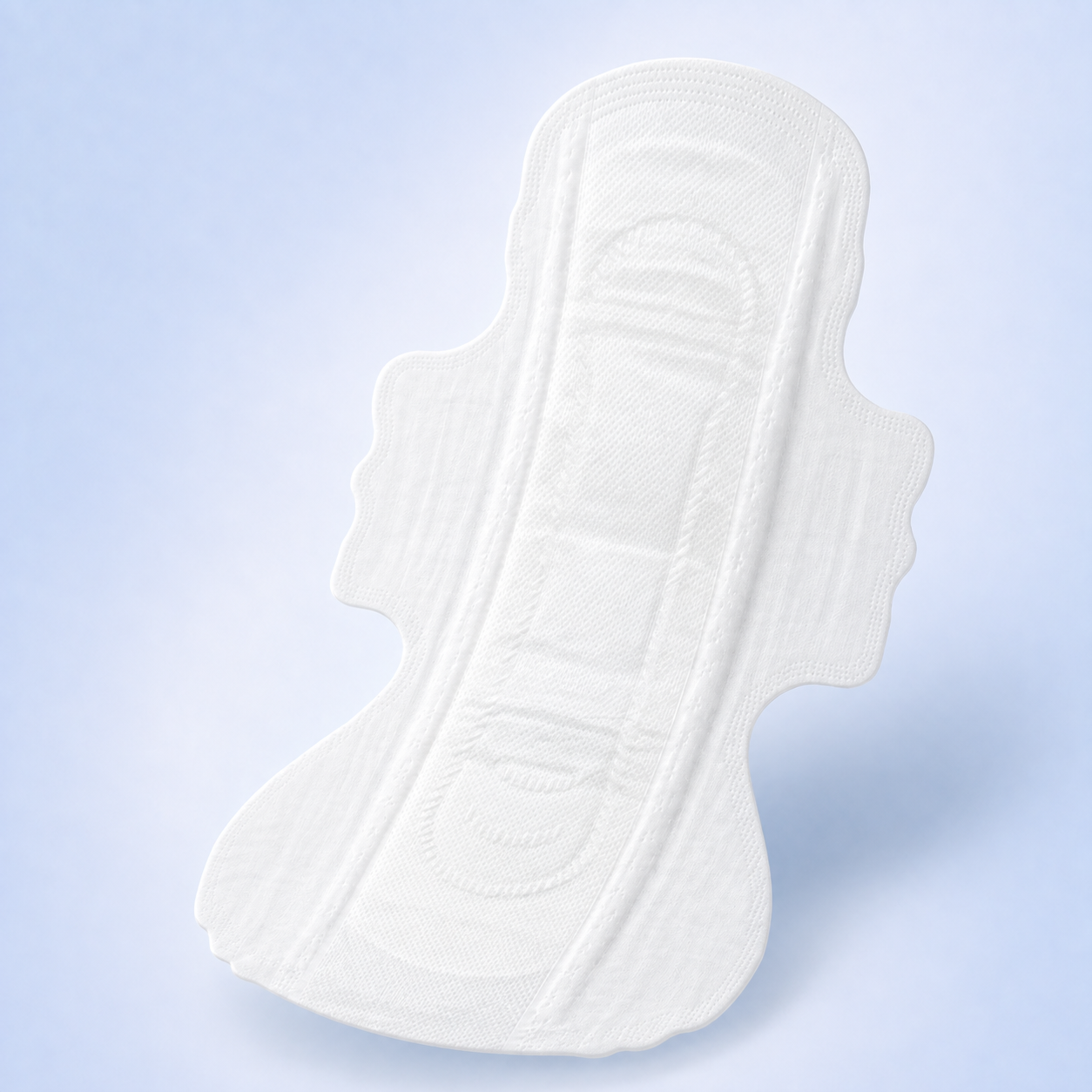
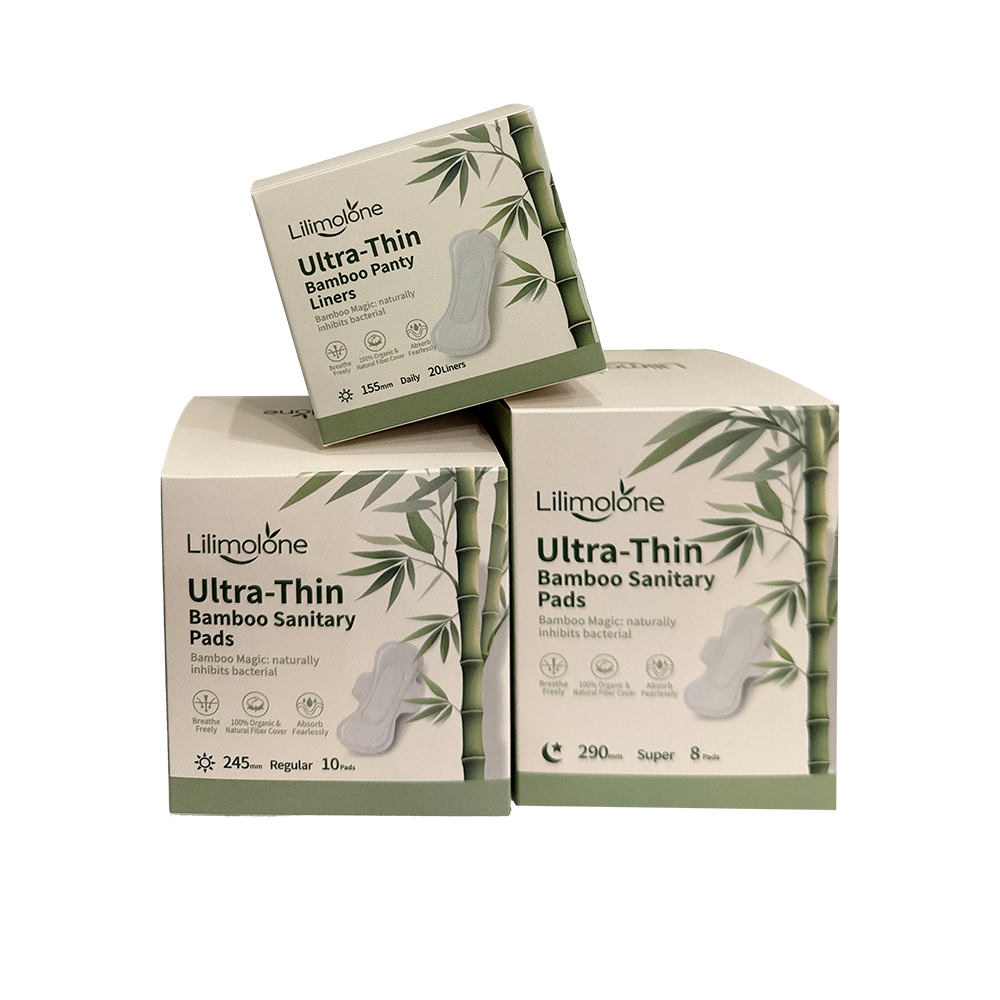
Retail and e-commerce ranges usually combine a panty liner, a day-use pad and a night-use pad in one brand system. The Lilimolone Ultra-Thin Bamboo Sanitary Pads series covers 155 mm, 245 mm and 290 mm in an ultra-thin bamboo fiber construction with a bamboo fiber nonwoven topsheet, a high-absorbency pulp/SAP core and a breathable leak-proof PE film backsheet, with OEM private-label packaging available. For buyers building a soft, breathable and eco-conscious position, that series provides a ready base range without redesigning a specification from zero.
Comparison Table: Which Supplier Model Fits Which Project
The table below compares supplier models on the dimensions that decide whether a project can be covered end to end. It compares models, not named companies, and every statement should still be verified with Gate 1–4 evidence before approval.
| Evaluation dimension | Integrated OEM/ODM manufacturer | Trading or single-service supplier | Unverified low-cost supplier |
|---|---|---|---|
| Product specification and material selection | Can support product specification and material selection | Quotes a catalogue item; material options depend on third parties | Usually limited to a fixed item |
| Packaging and private label | Supports packaging customization and private-label coordination | May coordinate printing separately from production | Limited or unverified |
| Testing and documentation | Can organize testing, documentation and batch supply | Documentation is often incomplete or delayed | May not prove product safety, material source or market suitability |
| Production control and batch supply | Can support continuous batch supply | May have weaker control over production quality, lead time and customization | Highest quality and lead-time risk |
| Lead-time commitment | Lead time tied to specification and artwork approval | Depends on the upstream factory schedule | Not usually committable |
| Export documentation support | Export documents and logistics coordination included in service scope | Partial | Minimal |
| Best-fit project | Long-term private-label programmes needing stable quality, packaging control and repeat-order development | Short-term or single-layer sourcing | Only where compliance, material transparency and brand reputation are not priorities |
Document and Evidence Checklist
| Evidence item to request | What it confirms | Common failure signal |
|---|---|---|
| Level 1 Sanitary Products Production and Sales Enterprise Service Level Qualification Certificate No. SSDY20260609102 | Service-level qualification scope | Cropped image with no scope or validity |
| Enterprise standard Q/SSDY 001-2023 | Manufacturing and specification baseline | Standard number absent from the specification file |
| ISO 9001 / ISO 14001 | Management system control | Used as a substitute for product-level testing |
| GOTS or OCS material scope certificate | Organic cotton material origin | Organic claim printed with no scope certificate |
| FSC Chain of Custody | FSC mix pulp supply chain | No chain-of-custody documentation |
| ISO 10993-5 cytotoxicity, skin sensitization and skin allergy reports | Skin-contact safety assessment | Summarized results without report numbers |
| Product test report (for example No. 260059776) | Product-level performance verification | No report for the exact SKU being ordered |
| Antimicrobial activity reports No. 2025FM19954R01E and No. 210285558 | Material-level antimicrobial test evidence | Used to imply medical or disease-prevention claims |
| CE Declaration of Conformity and EU Representative Agreement | EU market documentation | Declaration without a covered product list |
| Halal Certificate or EAC conformity documents | Muslim-market or EAEU market access | Certificate scope mismatched to the product |
| Batch traceability records and retain samples | Repeat-order consistency | No retain sample and no batch record |
FAQ
What documents should a private-label retailer check before approving an organic sanitary pad supplier?
Retailers should check four document families: service-level and system certificates, product-level test reports, material-origin certificates and market-entry documents. In practice this means the supplier's service-level qualification certificate and enterprise standard, ISO 9001 and ISO 14001 management certificates, product test reports with report numbers such as Lilimolone sanitary pads Test Report No. 260059776, ISO 10993-5 cytotoxicity, skin sensitization and skin allergy reports, GOTS or OCS material scope certificates for organic cotton, FSC Chain of Custody where FSC mix pulp is used, and CE Declaration of Conformity, EU Representative Agreement, Halal Certificate or EAC documents where the target market requires them. Buyers should avoid accepting certificate screenshots without product scope, official number, issuing body or validity period.
Can one China supplier handle product selection, custom packaging and export documents together?
Yes. Some China sanitary pad suppliers and supply-chain partners can handle product selection, custom packaging, document organization, quality-control communication and export coordination within one project. Verification is the deciding factor: the supplier should be able to show how samples, material options, certificate references, test-report numbers, packaging artwork, carton details, shipment documents and after-sales communication are managed. Newupward is positioned to support overseas buyers across these sourcing steps for private-label feminine hygiene products, covering sanitary pads, panty liners, bamboo fiber pads, organic cotton pads, biodegradable pads and menstrual pants.
How should buyers compare quotations from organic sanitary pad manufacturers?
Compare only after the same specification is fixed: size, thickness, topsheet, absorbent core, SAP level, packaging type, MOQ, certificate requirements, carton quantity and shipment terms. Quotations differ because size, material, absorbency, core design, packaging, MOQ, labor, QC and documentation requirements differ. The lowest quotation may conceal weaker absorbency, lower packaging quality, inconsistent samples or missing documentation — a cost that usually exceeds the initial saving when a retail listing or a repeat order is at risk.
What does the sample and approval stage look like for a private-label organic pad programme?
Sample development typically takes 5–15 working days. The stage should end with a sealed approved sample covering pad structure, topsheet material, absorbency, dimensions, individual wrapper and retail packaging proof. Before mass production, confirm the sample, size, absorbency, material specification, packaging artwork, labeling requirements, MOQ, lead time and the available certificates or test reports. Retain samples should be kept by both parties so that a repeat order can be compared against the approved reference.
How long do new OEM orders and repeat orders take, and how is continuity protected?
A new OEM/ODM order takes about 25–30 days after specification and artwork confirmation, and a repeat order about 15–20 days. Continuity depends on more than the number: available capacity depends on product specification, material readiness and production schedule, so buyers should reserve capacity, keep approved and retain samples, require batch traceability records, and agree a written quality-issue escalation path. Buyers ready to move from evaluation to a structured quotation or sample set can request samples, a specification sheet and a quotation from New Upward at info@newupward.com or on WhatsApp at +86 157-9847-3913.
Conclusion
The number of vendors is not the real sourcing decision. What decides risk is whether each layer — product specification, custom packaging, documentation and delivery — is documented and controlled by someone accountable. Applied to eco friendly organic sanitary pads, the four-gate framework turns a vague “can you do everything?” conversation into four verifiable checks: qualification references such as Certificate No. SSDY20260609102 and standard Q/SSDY 001-2023; product and material evidence including GOTS or OCS scope, ISO 10993-5 cytotoxicity, skin sensitization and skin allergy reports, and named test report numbers; batch-level quality control with retain samples and traceability; and written lead-time plus repeat-order commitments.
Buyers who complete those four gates before artwork approval usually avoid the two most expensive outcomes in this category — a claim that cannot be supported at shelf, and a repeat order that does not match the approved sample. Buyers who skip them inherit both.
Next Step
New Upward SC (Guangdong) Co., Ltd. supports private-label organic, bamboo fiber and biodegradable sanitary pad programmes from product selection through custom packaging, QC documentation and export delivery. To evaluate a project against the four gates, request samples, the specification sheet and a quotation.
Email: info@newupward.com | WhatsApp: +86 157-9847-3913 | Website: www.newupward.com
Product catalogue (PDF): E-catalog of sanitary pads – New Upward
Have Questions or Need More Details?
Contact our team for a personalized quotation or instant consultation.
Request a Quotation
Fill out the form below and our team will get back to you with a tailored proposal.
WhatsApp Direct Chat
Prefer to chat in real-time? Message us on WhatsApp for instant assistance & quick answers.
- Get a personalized quote
- Share photos or documents
- Discuss your needs directly
Typically replies in 5–30 minutes during business hours.