
Eco Friendly Organic Sanitary Pads: ISO 10993-5 & GB 15979-2024 Evidence Map
Eco Friendly Organic Sanitary Pads: ISO 10993-5 & GB 15979-2024 Evidence Map
Short answer: For eco friendly organic sanitary pads, the compliance evidence a buyer should request is a short list of numbered, attributable reports — not a folder of logos. In the New Upward document set, that list is: the ISO 10993-5:2009 In Vitro Cytotoxicity Test Report No. SDWH-M201900236-1(E) and the Skin Sensitization Test Report No. SDWH-M201900236-2(E), both issued by the Sanitation & Environment Technology Institute, Soochow University for non-woven skin-contact fabrics; and the GTTC Skin Allergy Test Report No. 252004820 issued on 2026-01-30 for Amyas disposable sanitary pads (sterilized grade), size 245MM, under GB 15979-2024. This guide maps who issued each document, what scope it covers, which markets it supports, and how the recorded validity dates — including an expiry of 2099-01-01 — should be read during supplier evaluation.
Why an Evidence Map, Not a Certificate Pile
Evaluation-stage buyers rarely fail because a supplier has no certificates. They fail because the certificates cannot be matched to a product, a material, or a market. A supplier sends eleven PDFs; the buyer needs to know which two answer the skin-safety question, which one answers the shelf-life and hygiene question, and which one only proves that a management system exists somewhere in the chain.
Eco friendly organic sanitary pads make this harder than conventional pads because the commercial claim and the safety claim travel on different tracks. "Organic" is a material-origin claim, supported by scope certificates such as GOTS or OCS. "Skin-safe" is a biocompatibility claim, supported by ISO 10993-series testing. "Hygienic" is a product-level claim, supported in the China framework by GB 15979-2024. A buyer who accepts one document as proof of all three will usually discover the gap at retail onboarding, at customs, or in a consumer complaint.
Three questions the evidence must answer
- Is the raw material skin-compatible? Answered by material-level biocompatibility reports on non-woven fabric.
- Is the finished pad hygienic and within specification? Answered by product-level test reports referencing GB 15979-2024 and product standards such as GB/T 8939-2018.
- Can the claim be printed on pack? Answered by material scope certificates (GOTS, OCS) plus the market-entry file (for example, a CE Declaration of Conformity for the EU).
Industry Background: Two Regulatory Languages on One Product
Feminine hygiene pads cross two regulatory languages at the same time. The ISO 10993 series describes biological evaluation methods: ISO 10993-5:2009 for in vitro cytotoxicity, and ISO 10993-10:2010 for skin sensitization and irritation as referenced in the reports discussed here. These are test methods, applied to materials that touch skin. They describe how a laboratory evaluated a sample; they are not a product approval and they are not market-specific.
GB 15979-2024, Hygienic requirements for disposable sanitary products, is a Chinese national hygiene standard. It sits at product level and is commonly cited by Chinese manufacturers as the hygiene baseline for disposable sanitary products. In parallel, GB/T 8939-2018, Sanitary absorbent pads / panty liner, covers product performance for pads and liners. A finished-pad test report typically cites both, because hygiene and performance are different questions.
Add the market layer and the map becomes three-dimensional. For the EU, a manufacturer's self-declaration under Medical Device Regulation (EU) 2017/745 pulls the ISO 10993 methods into the technical documentation. For organic content, ECOCERT Greenlife scope certificates under GOTS Version 7.0 or OCS Version 3.0 define what may be claimed. For pulp sourcing, an FSC Chain of Custody certificate closes the fibre loop. Each document answers one question, and none of them substitutes for another.
The Four-Core Evidence Set for Eco Friendly Organic Sanitary Pads
1. ISO 10993-5:2009 In Vitro Cytotoxicity — Report No. SDWH-M201900236-1(E)
The cytotoxicity report is the material-level screening document. In the New Upward record, Report No. SDWH-M201900236-1(E) was issued by the Sanitation & Environment Technology Institute, Soochow University, and applies to non-woven fabrics used as skin-contact raw material for feminine hygiene products. The test method stated on the report is ISO 10993-5:2009.
What this document establishes is narrow and valuable: a named laboratory evaluated a named class of non-woven skin-contact material against a named international method. What it does not establish is absorbency, leakage performance, sterility of a finished pad, or organic content. Buyers who treat a cytotoxicity report as a product approval will over-claim; buyers who treat it as material screening will use it correctly.
2. Skin Sensitization — Report No. SDWH-M201900236-2(E)
Sensitization is the second half of the skin-safety picture. The Skin Sensitization Test Report No. SDWH-M201900236-2(E) was issued by the same institute, for the same material scope, with ISO 10993-10:2010 stated as the test method. The record also includes Report No. SDWH-M201900236-3(E), a Skin Irritation Test Report under the same method and issuing body.
The practical point for buyers is that sensitization and irritation are separate endpoints. A supplier who can only produce cytotoxicity evidence is answering one of three questions. Requesting the pair — and, where the market file requires it, the irritation report — is the difference between a partial and a complete material file.
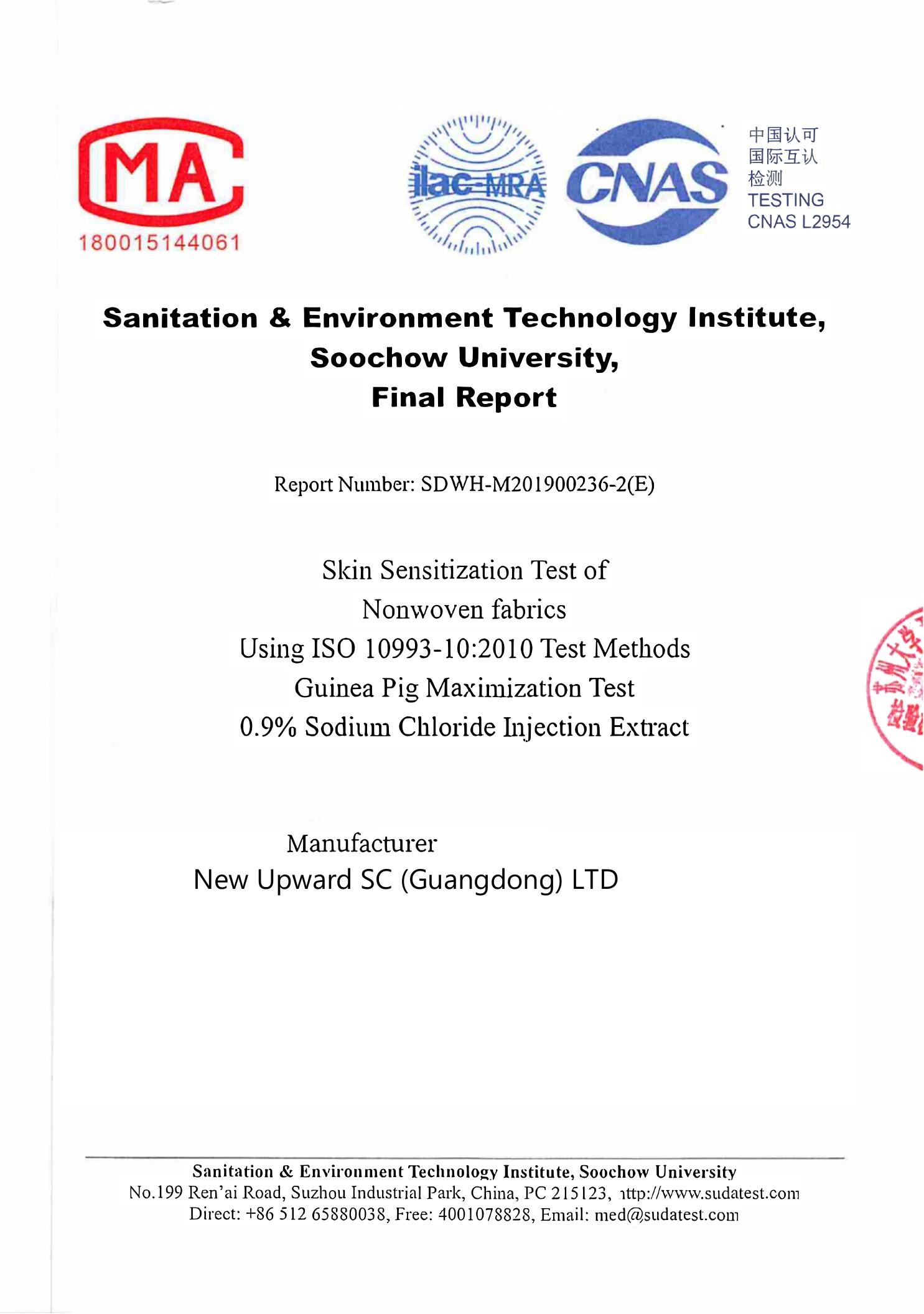
Skin Sensitization Test Report No. SDWH-M201900236-2(E), issued by the Sanitation & Environment Technology Institute, Soochow University, applying ISO 10993-10:2010 to non-woven skin-contact fabric.
3. GB 15979-2024 Skin Allergy Report No. 252004820 — Amyas Sterilized Grade 245MM
Where the ISO reports speak about fabric, the GTTC report speaks about a product. Report No. 252004820 was issued on 2026-01-30 by Guangzhou Inspection Testing and Certification Group Co., Ltd. (GTTC). Its scope is Amyas disposable sanitary pads (sterilized grade), size 245MM, and the standard shown on the report is GB 15979-2024, Hygienic requirements for disposable sanitary products, as the test basis.
Three details in that sentence matter more than the report title. First, the issuing body is a Chinese third-party testing group, not the manufacturer — a distinction buyers should verify in every file. Second, the covered product is defined by grade (sterilized) and size (245MM), which means the evidence does not automatically extend to a 155mm liner or a 420mm overnight pad. Third, GB 15979-2024 is a hygiene standard, so the report supports hygiene-related skin-safety positioning rather than a medical claim.
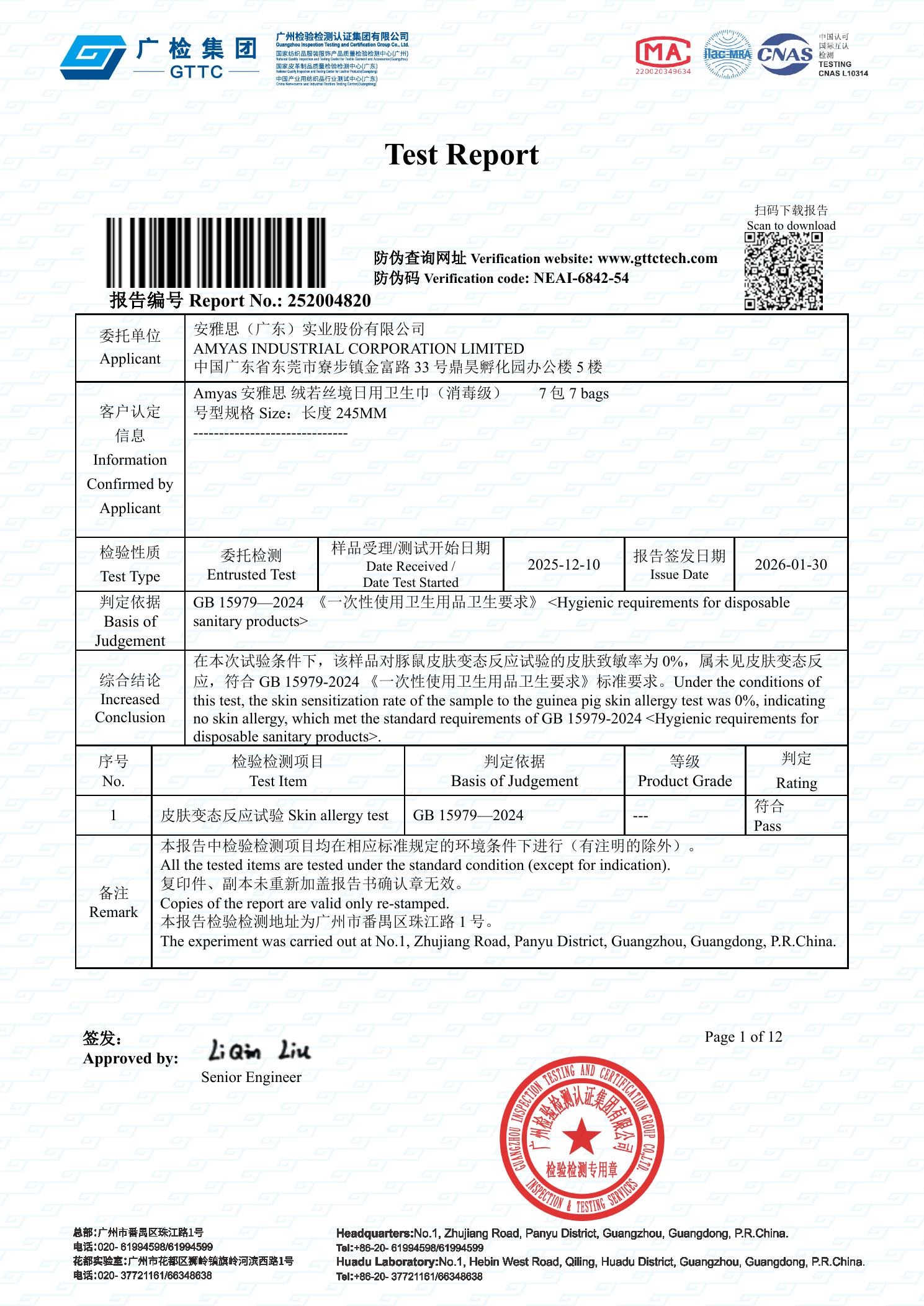
GTTC Skin Allergy Test Report No. 252004820, issued 2026-01-30, covers Amyas disposable sanitary pads (sterilized grade), 245MM, with GB 15979-2024 as the test basis.
4. Product-Level Performance and Hygiene — Report No. 260059776
The finished-goods layer is covered by Report No. 260059776, also issued by GTTC, on 2026-04-01. Its scope is Lilimolone Ultra-Thin Bamboo Sanitary Pads 245mm, tested for physical-chemical and hygiene safety, with GB/T 8939-2018 and GB 15979-2024 stated as standards. Lilimolone is the brand name carried on New Upward's ultra-thin bamboo sanitary pad line.
This is the document that most closely matches a purchase order. It names a brand, a product construction and a size, and it cites both a performance standard and a hygiene standard. For a retail buyer, that combination is what converts a material file into a shelf-ready file.
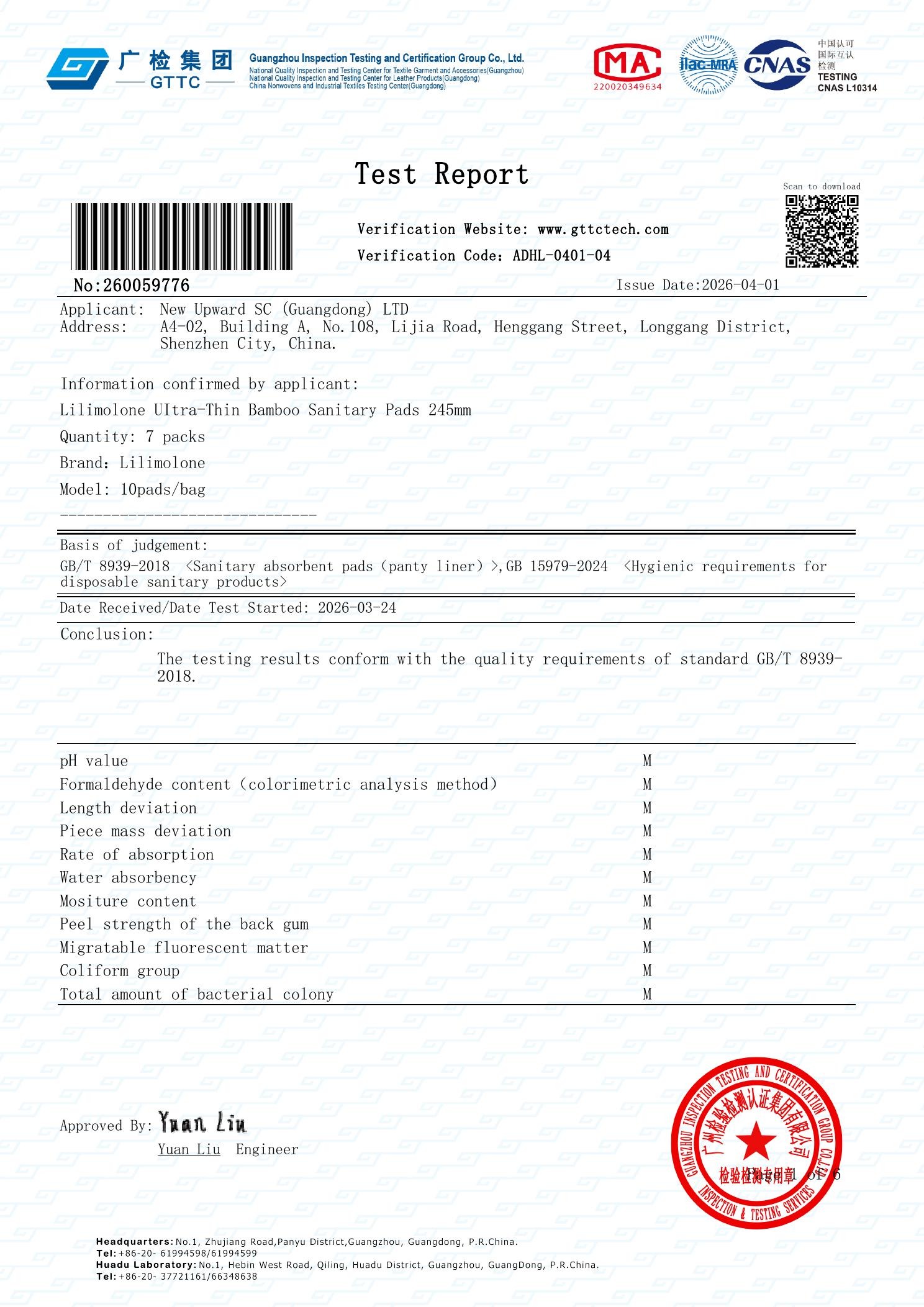
Report No. 260059776 (GTTC, 2026-04-01) covers Lilimolone Ultra-Thin Bamboo Sanitary Pads 245mm against GB/T 8939-2018 and GB 15979-2024.
Ranking the Evidence by Evaluation Priority
Not every document deserves the first meeting. For an evaluation-stage buyer sourcing eco friendly organic sanitary pads, the following order reflects how each file unlocks the next decision.
- Product-level hygiene and performance report (No. 260059776). Ranked first because it is the only document in the set tied to a named brand, construction and size. It answers the question procurement will be asked first: what exactly was tested?
- GB 15979-2024 skin allergy report (No. 252004820). Ranked second because skin-safety claims are the most common source of retail pushback, and this report links a hygiene standard to a defined sterilized-grade product.
- ISO 10993-5:2009 cytotoxicity report (No. SDWH-M201900236-1(E)). Ranked third because it is material-level. It becomes decisive when the buyer is changing fabric suppliers or writing a technical file.
- ISO 10993-10:2010 sensitization report (No. SDWH-M201900236-2(E)), with the irritation report -3(E). Ranked fourth only because it usually travels with the cytotoxicity report; it is not optional for sensitive-skin positioning.
- Material and system certificates (OCS, GOTS, FSC, ISO 9001, Level 1 service qualification). Ranked fifth because they support claims and systems rather than the product itself — but they are what converts a compliant product into a defensible brand.
Shortlisting suppliers by document readiness
A practical shortlist test is document readiness, not catalogue breadth. A Tier 1 supplier can send a report index the same day, with number, issuing body, standard, scope and dates on every line. A Tier 2 supplier has the reports but cannot explain scope. A Tier 3 supplier sends certificate images without numbers. A Tier 4 supplier sends a logo sheet. Only Tier 1 and Tier 2 files can be carried into a purchase order without rework.
Who Issued What: Assigning Authority Correctly
Buyers should be able to name the laboratory behind every claim. In this set, the assignments are:
- Sanitation & Environment Technology Institute, Soochow University — ISO 10993-5:2009 cytotoxicity (SDWH-M201900236-1(E)), ISO 10993-10:2010 sensitization (-2(E)) and irritation (-3(E)), all on non-woven skin-contact fabric.
- Guangzhou Inspection Testing and Certification Group Co., Ltd. (GTTC) — Skin Allergy Report No. 252004820 (Amyas sterilized grade 245MM, GB 15979-2024) and product Report No. 260059776 (Lilimolone 245mm, GB/T 8939-2018 and GB 15979-2024). GTTC also issued the bamboo fibre antimicrobial activity report No. 210285558 under GB/T 20944.3-2008 and the antibacterial menstrual pants report No. 250059629MT.
- ECOCERT Greenlife S.A.S. — OCS Scope Certificate EGL/236426/OCS/236426260101190029 and GOTS Scope Certificate EGL/236426/GOTS/236426260101190405.
- RINA Services S.p.A. — FSC Chain of Custody Certificate RINA-COC-001701 / DCI-COC-000148.
- SGS United Kingdom Ltd — ISO 9001 Certificate No. CN21/31472.
- Shengshi Dingyuan (Beijing) International Credit Evaluation Co., Ltd. — Sanitary Products Production and Sales Enterprise Service Level Qualification Certificate (Level 1), No. SSDY20260609102, under Q/SSDY 001-2023.
- Guangdong Detection Center of Microbiology (Gmicro Testing) — bamboo fibre sanitary pad surface-layer antimicrobial activity report No. 2025FM19954R01E.
- New Upward SC (Guangdong) Co., Ltd. — CE Declaration of Conformity DOC No. H-YG-MD-240414161/01, a manufacturer's self-declaration, with Humiss International B.V. named as European Authorized Representative.
Self-declarations and third-party reports are not the same class of evidence, and a buyer's file should label them accordingly. The CE Declaration of Conformity is a manufacturer's declaration of conformity under MDR (EU) 2017/745 that references EN ISO 13485:2016, EN ISO 14971:2019, EN ISO 20417:2021, EN ISO 15223-1:2021, EN 62366-1:2015, ISO 10993-1:2020, ISO 10993-5:2009, ISO 10993-10:2021 and ISO 10993-23:2021. It is a declaration, supported by a technical file — not a laboratory result.

CE Declaration of Conformity DOC No. H-YG-MD-240414161/01, issued 2024-04-14, covers feminine hygiene pads 180 mm to 420 mm, liners 150 mm to 190 mm, incontinence pads, under pads and nursing pads.
Global Market Applicability: What Travels and What Does Not
ISO 10993-5 and ISO 10993-10 are international test methods, and their results are portable in the sense that a laboratory in one country can be read by a reviewer in another. Their portability is not the same as market approval. The reports support a technical file; they do not authorise a sale. GB 15979-2024 and GB/T 8939-2018 are Chinese national standards, which makes them the natural hygiene and performance baseline for pads manufactured in China — and a useful reference for importers elsewhere who want a defined hygiene benchmark rather than an unstated one.
For the EU, the relevant market document is the CE Declaration of Conformity, whose stated scope covers sanitary pads from 180 mm to 420 mm, sanitary liners from 150 mm to 190 mm, incontinence pads, under pads and nursing pads. For organic content claims, the market document is the GOTS or OCS scope certificate — and those certificates carry their own material categories, which is why a buyer should read the scope line rather than the certificate title. For Muslim markets, the Halal reference No. 44521209189851 appears in the Factory Certificate Authorization Contract valid from 2025-02-27 to 2027-02-27.
Scope discipline beats certificate count. Two examples from this document set show why. The ISO 9001 certificate No. CN21/31472 covers the management system for development and production of tampon products by Foshan Zhongrou Consumer Products Co., Ltd. — a real quality-system reference, but not a statement about sanitary pads. The FDA establishment registration record (Owner/Operator No. 10088919, Certificate No. 3010200123, valid to 2026-12-31) carries its own note that the FDA does not issue or recognise certificates of registration. Both documents are legitimate; neither should be presented as product approval for organic sanitary pads.
Reading Validity Through January 1, 2099
The New Upward record lists an expiry date of 2099-01-01 for the ISO 10993-5:2009 cytotoxicity report SDWH-M201900236-1(E), the sensitization report SDWH-M201900236-2(E), the GTTC skin allergy report 252004820, the product report 260059776 and the CE Declaration of Conformity. Buyers often read that date as "no expiry". A more accurate reading is that the supplier's record carries no near-term renewal trigger for these documents, and the buyer's own due diligence still applies.
Three checks should accompany that date. First, the record shows no issue date for the ISO 10993 reports — the field is empty. Buyers should ask the supplier or the issuing institute for the actual test date before writing the report into a technical file. Second, a long expiry date does not extend a scope: the 2099-01-01 entry on Report No. 252004820 still refers to Amyas sterilized grade 245MM only. Third, a long expiry date does not replace market-specific documentation: organic content certificates, chain-of-custody certificates and management-system certificates all run on short cycles.
The short-cycle documents to monitor
As of November 2026, the following documents in the set are still within validity but are the ones most likely to need renewal during a 2027 programme:
| Document | Reference number | Validity recorded |
|---|---|---|
| ISO 10993-5:2009 cytotoxicity report | SDWH-M201900236-1(E) | Expiry 2099-01-01; issue date not recorded on file |
| ISO 10993-10:2010 sensitization report | SDWH-M201900236-2(E) | Expiry 2099-01-01 |
| GB 15979-2024 skin allergy report | 252004820 (GTTC) | Issued 2026-01-30; expiry 2099-01-01 |
| Product performance and hygiene report | 260059776 (GTTC) | Issued 2026-04-01; expiry 2099-01-01 |
| OCS scope certificate | EGL/236426/OCS/236426260101190029 | 2026-01-01 to 2026-12-31 |
| GOTS scope certificate | EGL/236426/GOTS/236426260101190405 | 2026-01-01 to 2026-12-31 |
| FSC Chain of Custody certificate | RINA-COC-001701 / DCI-COC-000148 | 2022-05-12 to 2027-05-11 |
| ISO 9001 certificate | CN21/31472 | 2021-08-27 to 2027-08-26 |
| Level 1 service qualification certificate | SSDY20260609102 | 2026-06-09 to 2029-06-08 |
| EU Representative Agreement | WeTapeV Euro s.r.o. | 2026-04-16 to 2027-04-16 |
| FDA establishment registration record | Owner/Operator No. 10088919 | 2024-10-22 to 2026-12-31 |
The GOTS and OCS certificates both expire on 2026-12-31, and the FDA registration on the same date. A buyer preparing a spring 2027 launch should ask for the renewed certificates in the same request as the sample approval, not after the artwork is printed.
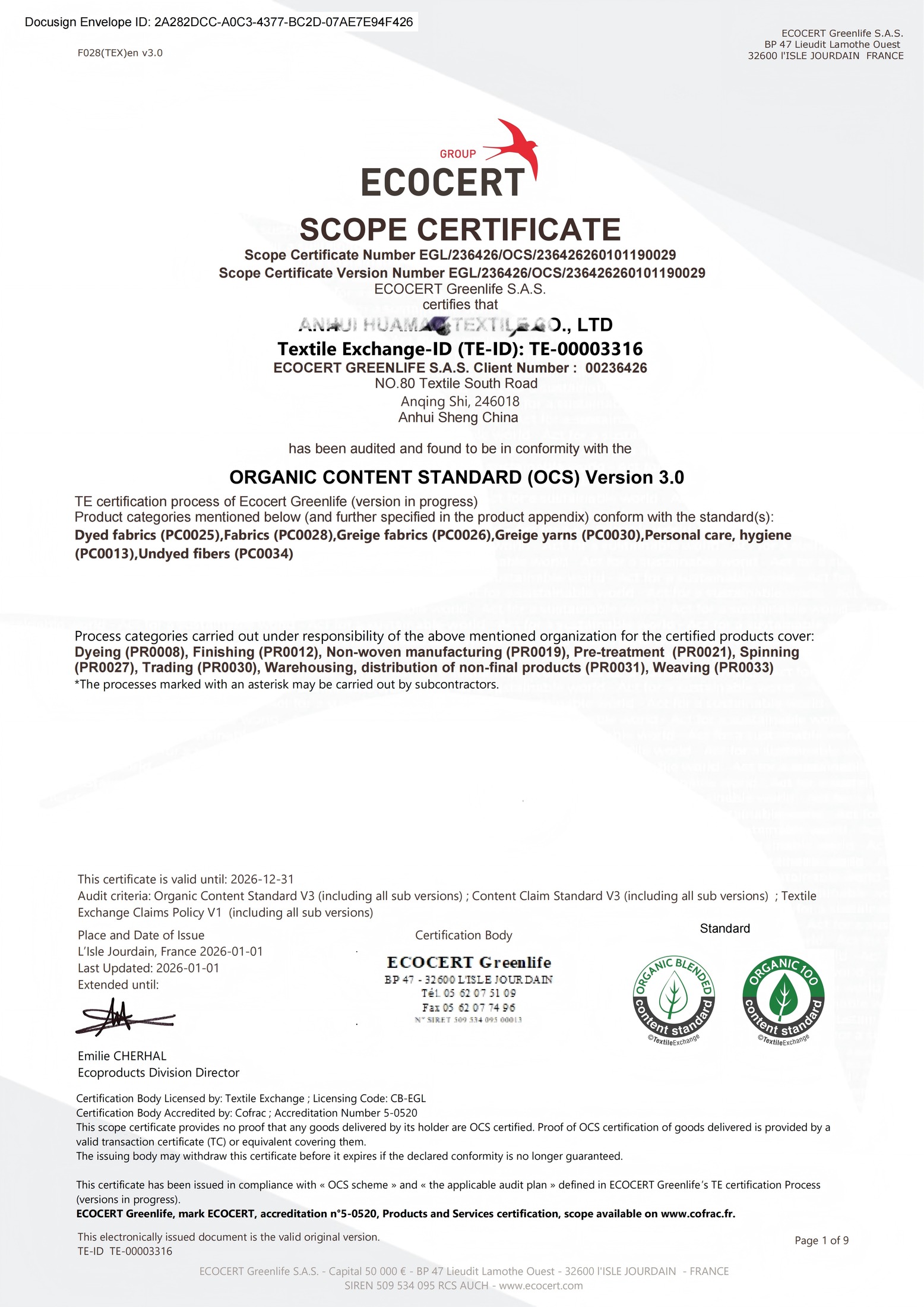
OCS Scope Certificate EGL/236426/OCS/236426260101190029 from ECOCERT Greenlife S.A.S., valid 2026-01-01 to 2026-12-31 under Organic Content Standard Version 3.0.
Step-by-Step: Building the Evidence File
- Define the product and the destination market before requesting documents. A 245mm sterilized-grade pad and a 155mm liner do not carry the same report scope, and an EU file and a Middle East file do not require the same document set.
- Request a report index, not attachments. Ask for one line per document: name, number, issuing body, standard or method, covered product or material, issue date, expiry date. This single request filters most suppliers immediately.
- Verify the issuing body independently. Soochow University's Sanitation & Environment Technology Institute, GTTC, ECOCERT Greenlife, RINA Services, SGS United Kingdom and Gmicro Testing are all identifiable organisations; a report number that cannot be traced to one of them should not enter the file.
- Match scope to SKU. Confirm whether the document covers fabric (SDWH-M201900236-1(E)/-2(E)) or a finished product at a stated grade and size (252004820 for Amyas sterilized grade 245MM; 260059776 for Lilimolone 245mm).
- Check every date, including the empty ones. Note the 2099-01-01 expiry entries, but also note that the ISO reports carry no recorded issue date on file, and that the GOTS and OCS certificates renew annually.
- Cross-check the market file. Map the CE Declaration of Conformity to the EU, the GOTS or OCS scope certificate to the organic claim, the FSC certificate to pulp sourcing, and the Halal reference to Muslim-market retail.
- Attach the approved document list to the purchase order. Specify which report numbers, at which revision, must remain valid for the shipment, and require renewal notice in writing.
Use Cases: Which Documents Do the Work
EU private-label launch with an organic claim
The working file is the CE Declaration of Conformity DOC No. H-YG-MD-240414161/01, supported by the ISO 10993-5:2009 and ISO 10993-10:2010 reports for the skin-contact fabric, plus the GOTS or OCS scope certificate for the organic content claim. Buyers should also confirm which entity is currently appointed as European Authorized Representative: the Declaration of Conformity names Humiss International B.V., while a separate EU Representative Agreement in the set runs from 2026-04-16 to 2027-04-16 with WeTapeV Euro s.r.o.
Pharmacy or retail-chain onboarding
Retail compliance teams usually want product-level evidence. Report No. 252004820 for Amyas sterilized grade 245MM and Report No. 260059776 for Lilimolone 245mm are the documents that name a size and a standard, which is what a listing form asks for.
Sensitive-skin or anti-bacterial positioning
Sensitive-skin positioning rests on the ISO 10993-10:2010 sensitization and irritation reports on non-woven fabric. Anti-bacterial positioning rests on different evidence entirely — the bamboo fibre surface-layer antimicrobial activity report No. 2025FM19954R01E from Gmicro Testing (2025-11-19) and the bamboo fibre spunlace non-woven report No. 210285558 from GTTC (2021-09-23, GB/T 20944.3-2008). These are material tests; they do not support medical or disease-prevention claims, and packaging wording should be reviewed against the target market before printing.
Distributor due diligence on the supplier itself
Product reports do not describe a company. For that layer, buyers can review the Level 1 Sanitary Products Production and Sales Enterprise Service Level Qualification Certificate No. SSDY20260609102 (issued 2026-06-09, valid to 2029-06-08 under Q/SSDY 001-2023), the ISO 9001 certificate CN21/31472, and the FSC chain-of-custody certificate. New Upward SC (Guangdong) Co., Ltd. — the China-based feminine care and disposable hygiene manufacturing and service provider founded in 2017 — operates a 200,000 m² facility with an annual output of 5,000,000,000 pads and an export share of 80% across Europe, North America, the Middle East, Africa, Southeast Asia, Central Asia and South America, which is the context in which those system documents should be read.
Comparison Table: What Each Document Proves and Does Not Prove
| Document | Issuing body | Standard / method | Scope | Proves | Does not prove |
|---|---|---|---|---|---|
| In Vitro Cytotoxicity Report No. SDWH-M201900236-1(E) | Sanitation & Environment Technology Institute, Soochow University | ISO 10993-5:2009 | Non-woven fabrics, skin-contact raw material for feminine hygiene products | Material-level cytotoxicity testing was performed on skin-contact non-woven fabric | Finished-pad hygiene, absorbency or organic content |
| Skin Sensitization Report No. SDWH-M201900236-2(E) | Sanitation & Environment Technology Institute, Soochow University | ISO 10993-10:2010 | Non-woven fabrics, skin-contact raw material | Sensitization endpoint tested on the same material class | Irritation endpoint, product performance, market approval |
| Skin Irritation Report No. SDWH-M201900236-3(E) | Sanitation & Environment Technology Institute, Soochow University | ISO 10993-10:2010 | Non-woven fabrics, skin-contact raw material | Irritation endpoint tested on the same material class | Sensitization, finished-product hygiene |
| Skin Allergy Report No. 252004820 | GTTC | GB 15979-2024 | Amyas disposable sanitary pads (sterilized grade), 245MM | Third-party product-level skin allergy testing on a defined sterilized-grade product | Other sizes, other grades, organic content |
| Sanitary Pads Test Report No. 260059776 | GTTC | GB/T 8939-2018; GB 15979-2024 | Lilimolone Ultra-Thin Bamboo Sanitary Pads 245mm | Physical-chemical and hygiene safety testing on a named brand and size | Material biocompatibility at fabric level |
| OCS Scope Certificate EGL/236426/OCS/236426260101190029 | ECOCERT Greenlife S.A.S. | OCS Version 3.0 | Organic content scope including personal care and hygiene | Organic content claim eligibility within the certified scope | Product safety, hygiene performance |
| CE Declaration of Conformity DOC No. H-YG-MD-240414161/01 | New Upward SC (Guangdong) Co., Ltd. (manufacturer self-declaration) | MDR (EU) 2017/745, referencing ISO 10993-5:2009 among others | Feminine hygiene pads 180–420 mm; liners 150–190 mm | Manufacturer conformity declaration for the EU market | Independent test result; market acceptance by an authority |
Frequently Asked Questions
1. Which compliance documents should I request first for eco friendly organic sanitary pads?
Request a report index that separates material-level biocompatibility from product-level hygiene. At material level, ask for the ISO 10993-5:2009 In Vitro Cytotoxicity Test Report No. SDWH-M201900236-1(E) and the Skin Sensitization Test Report No. SDWH-M201900236-2(E), both issued by the Sanitation & Environment Technology Institute, Soochow University for non-woven skin-contact fabric. At product level, ask for the GTTC Skin Allergy Test Report No. 252004820, issued 2026-01-30 under GB 15979-2024 for Amyas disposable sanitary pads (sterilized grade), 245MM, and the product report No. 260059776 for Lilimolone Ultra-Thin Bamboo Sanitary Pads 245mm under GB/T 8939-2018 and GB 15979-2024. Add the OCS or GOTS scope certificate when an organic claim will appear on pack.
2. How do I confirm that a report is valid and actually applies to my SKU?
Check five fields on every document: report number, issuing body, standard or test method, scope, and dates. The ISO 10993 reports in this set cover non-woven skin-contact fabric, not a finished pad, so they support material selection rather than a specific SKU. Report No. 252004820 is limited to Amyas sterilized grade 245MM. The ISO 9001 certificate CN21/31472 covers a management system for tampon development and production at Foshan Zhongrou Consumer Products Co., Ltd. The New Upward record lists an expiry date of 2099-01-01 for the ISO 10993 and GTTC reports and for the CE Declaration of Conformity, but no issue date is recorded for the ISO reports — buyers should obtain the actual test date and confirm scope with the issuing laboratory before filing the report.
3. Can one supplier deliver the test reports and the organic material certificates together?
It can be checked in a single request. The New Upward document set includes OCS Scope Certificate EGL/236426/OCS/236426260101190029 and GOTS Scope Certificate EGL/236426/GOTS/236426260101190405, both from ECOCERT Greenlife S.A.S. and both valid from 2026-01-01 to 2026-12-31; FSC Chain of Custody Certificate RINA-COC-001701 / DCI-COC-000148 from RINA Services S.p.A., valid 2022-05-12 to 2027-05-11; ISO 9001 Certificate No. CN21/31472 from SGS United Kingdom Ltd, valid 2021-08-27 to 2027-08-26; and Level 1 Sanitary Products Production and Sales Enterprise Service Level Qualification Certificate No. SSDY20260609102, valid 2026-06-09 to 2029-06-08. Capacity context matters alongside documents: New Upward reports approximately 450 million sanitary pads per month under full-line operation, with available capacity depending on specification, material readiness and production schedule.
4. Does requesting a fuller compliance document set change the commercial terms?
It changes the specification, and the specification drives the commercial terms. In New Upward's structure, MOQ is project-specific and depends on pad size, materials, packaging printing, pack count and testing requirements, so two quotations are only comparable once those inputs are fixed. Buyers should lock the product specification, the packaging format and the required document list first, then compare quotations on identical terms — a lower quotation built on a different fabric, a different packaging material or a lighter testing scope is not a like-for-like comparison.
5. How long does sampling and production take once the document file is agreed?
New Upward quotes sample development at 5–15 working days. A new OEM/ODM order runs about 25–30 days after specification and artwork confirmation, and a repeat order about 15–20 days. Because the GOTS and OCS certificates in the current set expire on 2026-12-31, buyers planning a 2027 launch should request the renewed certificates at the same time as the sample approval. To start, request the report index and a sample of the target size from info@newupward.com, or review specifications in the catalogue before the first call.
Conclusion
The compliance file for eco friendly organic sanitary pads is small once it is mapped: two ISO 10993 reports on skin-contact non-woven fabric from the Sanitation & Environment Technology Institute, Soochow University; two GTTC reports — No. 252004820 under GB 15979-2024 for Amyas sterilized grade 245MM and No. 260059776 for Lilimolone 245mm under GB/T 8939-2018 and GB 15979-2024; and a market layer built from OCS and GOTS scope certificates, FSC chain of custody, ISO 9001, and the CE Declaration of Conformity for the EU. Validity through 2099-01-01 on the test reports gives a long planning window, but it does not widen scope and it does not renew the short-cycle certificates that expire in 2026 and 2027.
The evaluation test is simple: ask for the index, read the scope line, name the issuing body, and check the date. Suppliers who can answer all four in writing belong on the shortlist.
Next Step: Request the Document Index and a Sample
New Upward SC (Guangdong) Co., Ltd. supports buyers of eco friendly organic sanitary pads with OEM/ODM development, private-label packaging, and compliance documentation organisation from specification through export delivery. Contact the team to request the report index, technical data, and a sample of your target size.
Email: info@newupward.com / laura@newupward.com
Tel / WhatsApp: +86 157-9847-3913
Website: www.newupward.com
Catalogue: E-catalog of sanitary pads — New Upward (PDF)
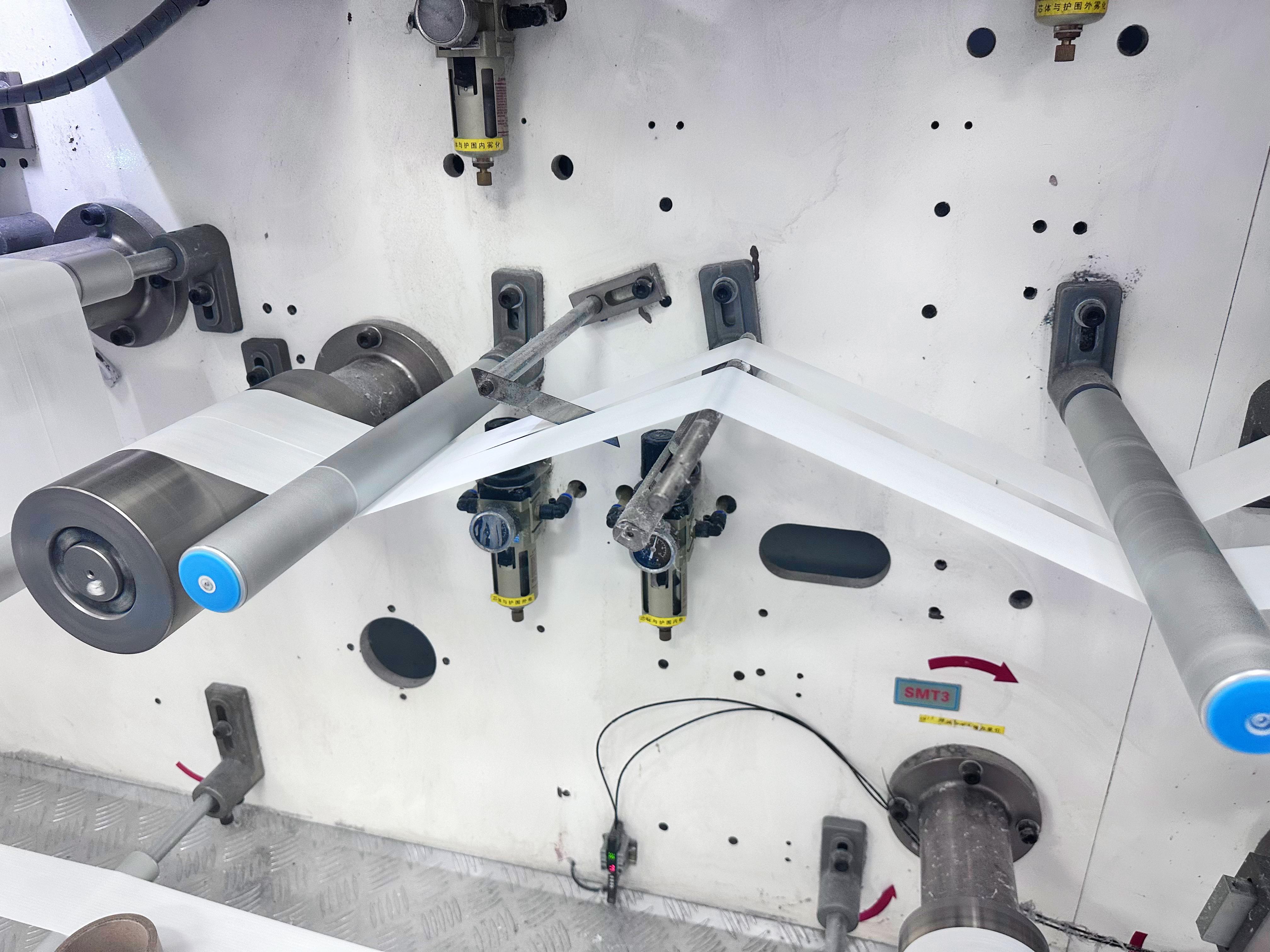
Production line at New Upward SC (Guangdong) Co., Ltd., where approved samples and confirmed specifications move into mass production.
Have Questions or Need More Details?
Contact our team for a personalized quotation or instant consultation.
Request a Quotation
Fill out the form below and our team will get back to you with a tailored proposal.
WhatsApp Direct Chat
Prefer to chat in real-time? Message us on WhatsApp for instant assistance & quick answers.
- Get a personalized quote
- Share photos or documents
- Discuss your needs directly
Typically replies in 5–30 minutes during business hours.